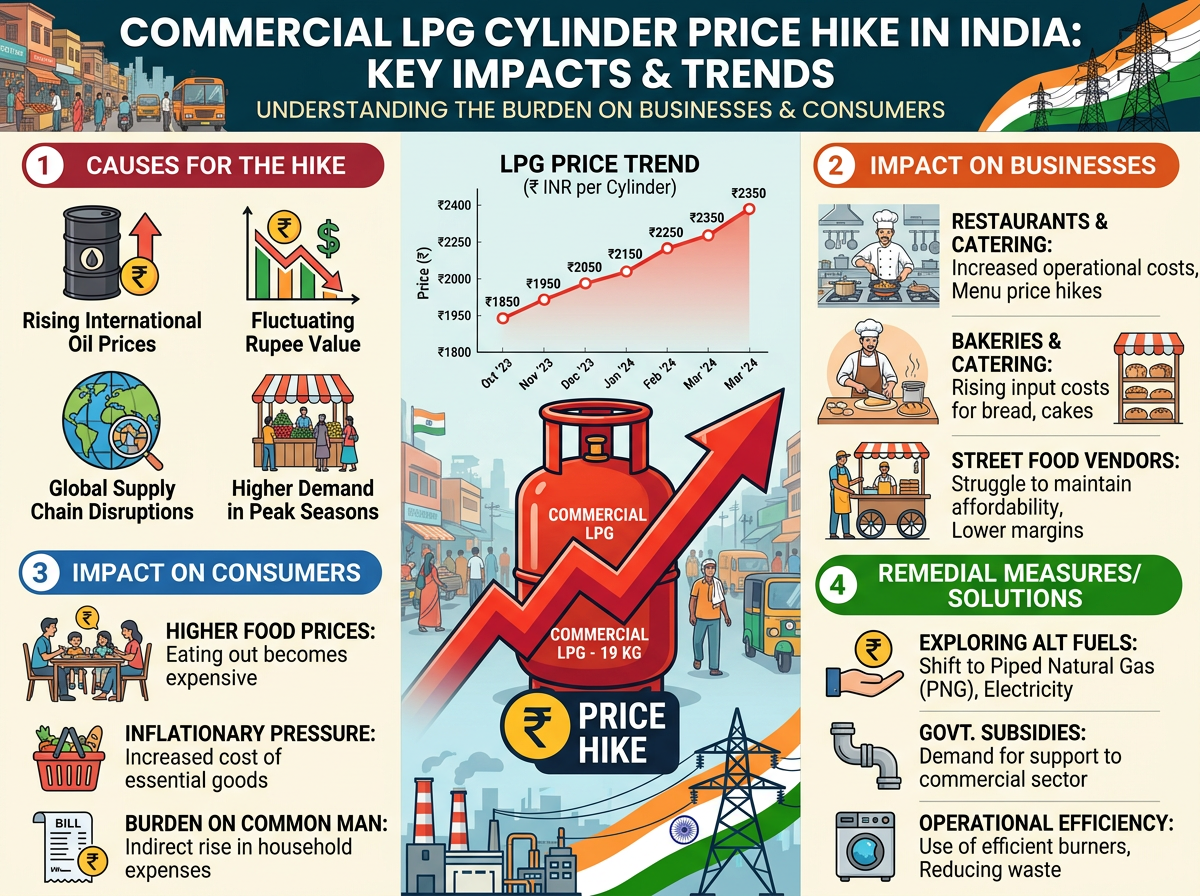
At a Glance: Commercial LPG Price Hike May 1, 2026
- Effective date: May 1, 2026 19 kg commercial LPG hike
- Delhi: Rs 993 (new price Rs 3,071.50) 19 kg commercial LPG hike
- Kolkata: Rs 1,147 (new price Rs 3,355) 19 kg commercial LPG hike
- Mumbai: Rs 993 to Rs 1,015.50 (new price Rs 3,024 to Rs 3,046.50) 19 kg commercial LPG hike
- Chennai: Rs 1,013 (new price Rs 3,259.50)
- 5 kg FTL cylinder hike: Rs 261
- 14.2 kg domestic LPG: Unchanged at Rs 913 in Delhi
- Petrol and diesel: Unchanged
- Who revised prices: Indian Oil (Indane), BPCL (Bharat Gas), HPCL (HP Gas)
- Number of commercial hikes since the Iran war began: Three
- Cumulative hike since March 2026: Rs 1,303
- Status: Steepest ever single hike on a 19 kg commercial cylinder
What Is the Commercial LPG Price Hike From May 1, 2026?
State-run oil marketing companies Indian Oil Corporation, BPCL and HPCL have revised commercial LPG cylinder prices sharply upward from May 1, 2026, in what The Tribune has described as the steepest ever single hike on a 19 kg commercial cylinder. The revision applies to the 19 kg commercial cylinder used by restaurants, dhabas, hotels, caterers, cloud kitchens and all other food service businesses across India.
The base hike is Rs 993 per cylinder in Delhi. However, after state-level taxes and local levies are applied, the effective increase varies significantly by city. Kolkata has seen the highest jump at Rs 1,147, making it the most expensive major metro for commercial cooking gas in India. The 5 kg Free Trade LPG cylinder, used by street vendors, tea stalls and small roadside operators, has also been hiked by Rs 261 per cylinder from today.
Domestic LPG cylinders used by 33 crore households remain unchanged. Petrol, diesel and kerosene supplied through the public distribution system are also unaffected. Indian Oil Corporation stated that around 80 percent of petroleum products have seen no change in prices, with revisions limited to commercial segments adjusted monthly against international benchmarks.
Complete City-Wise 19 Kg Commercial LPG Rates From May 1, 2026
The hike is not uniform across India. State VAT rates, local levies and distributor margins create significant price differences between cities. Here is the full breakdown.
| City | Previous Price (Rs) | New Price (Rs) | Effective Hike (Rs) |
| Delhi | 2,078.50 | 3,071.50 | 993.00 |
| Mumbai | 2,031.00 | 3,024.00 to 3,046.50 | 993 to 1,015.50 |
| Kolkata | 2,208.00 | 3,355.00 | 1,147.00 |
| Chennai | 2,246.50 | 3,259.50 | 1,013.00 |
| Bengaluru | 2,159.00 | 3,152.00 | 993.00 |
| Thiruvananthapuram | 2,113.00 | 3,106.00 | 993.00 |
| Lucknow | 2,201.00 | 3,194.00 | 993.00 |
| Hyderabad | 2,140.00 | 3,133.00 | 993.00 |
| Pune | 2,038.00 | 3,031.00 | 993.00 |
| Coimbatore | 2,244.00 | 3,237.00 | 993.00 |
Why do Kolkata and Mumbai see higher hikes than Delhi?
The base hike from oil marketing companies is Rs 993 per cylinder before state taxes. West Bengal and Maharashtra apply higher VAT on commercial LPG than Delhi, which is why the effective increase in Kolkata reaches Rs 1,147 and Mumbai exceeds Rs 993. The variation is not the oil companies charging different amounts but state governments collecting different taxes on the same product.
Prices may vary marginally by distributor within the same city. Verify your exact rate at indianoil.in, bharatgas.in or hpgas.in before booking.
Why Has Commercial LPG Been Hiked So Steeply? The Iran War, the Strait of Hormuz and What the Government Has Not Said Loudly
The Rs 993 base hike did not come from nowhere. Three interconnected factors produced it simultaneously.
India’s LPG import dependence is the structural vulnerability
According to the Press Information Bureau, India’s official government communications office, India imports approximately 60 percent of its LPG consumption. Of these imports, approximately 90 percent transit through the Strait of Hormuz, the narrow waterway between Iran and Oman through which a fifth of global energy trade passes. This single dependency, 90 percent of 60 percent of national consumption flowing through one contested waterway, is the foundation of everything that has happened to commercial LPG prices since February 2026.
The Iran war closed that waterway
When the US-Israel-Iran conflict escalated in late February 2026, the Strait of Hormuz became a crisis zone. Before the war, India imported 626,000 tonnes of LPG from the UAE alone in February 2026. By April 2026, UAE LPG shipments to India had fallen to 163,000 tonnes, a 74 percent decline in two months from India’s single largest supply source. India has been scrambling to replace these volumes, sourcing a record 361,000 tonnes from the United States in April 2026. But alternative suppliers charge higher prices and face significantly longer shipping routes, meaning replacement volumes come at a higher cost even when available.
Crude oil spiked. Oil companies absorbed as long as they could.
Crude oil prices surged above $110 per barrel, touching $120 at the peak of the conflict, compared to levels closer to $85 to $90 per barrel in late 2025. International LPG benchmark prices followed. Oil marketing companies absorb these cost increases across monthly revision cycles rather than passing them through daily. By the time the May 1 revision date arrived, under-recoveries on commercial cylinders, according to industry estimates, stood at approximately Rs 380 per cylinder. The May 1 hike is therefore not just a reflection of current costs but also a partial catch-up for losses absorbed in March and April.
This Is the Third Commercial LPG Hike in 60 Days: The Complete Price Timeline Since the Iran War Began
Three hikes. Sixty days. Rs 1,303 more per cylinder.
| Date | Hike Amount | Running Total From Pre-War Price |
| March 1, 2026 | Rs 114.50 | Rs 114.50 |
| April 1, 2026 | Rs 195.50 | Rs 310.00 |
| May 1, 2026 | Rs 993.00 | Rs 1,303.00 |
A 19 kg commercial cylinder that cost approximately Rs 1,768.50 in Delhi before the Iran war began now costs Rs 3,071.50. That is an increase of approximately 74 percent in 60 days.
“A cylinder that cost Rs 1,768 before the Iran war costs Rs 3,071 today. That is not an energy price adjustment. That is an energy crisis arriving at the kitchen door of every dhaba in India.”
The May revision is also of a completely different order of magnitude than the previous two. The March and April hikes of Rs 114.50 and Rs 195.50 were absorbed relatively quietly by the food service industry. The May hike of Rs 993, nearly five times the April hike, is not absorbable. It lands on businesses already weakened by two previous increases and an already collapsing demand curve. Total LPG consumption in India declined by 13 percent year on year in March 2026 as supply disruptions took hold. Commercial LPG sales specifically collapsed by almost 48 percent year on year in March, according to data from the government’s own Petroleum Planning and Analysis Cell.
How This Wrecks the Math for Restaurants, Dhabas and Small Food Businesses
The impact splits sharply along business size. The arithmetic is unforgiving at the small end.
- Large restaurant chains and cloud kitchens are the most insulated. Many have either migrated to Piped Natural Gas connections or hold bulk procurement agreements with distributors. For them the hike is a margin squeeze, not a survival question.
- Mid-sized restaurants using 15 to 25 cylinders per month face additional monthly fuel costs of Rs 15,000 to Rs 25,000 under the new rates. This is painful but potentially survivable through gradual menu price increases over May and June.
- Roadside dhabas and small eateries using 10 to 15 cylinders per month face the sharpest arithmetic. A Delhi dhaba that spent Rs 31,000 per month on commercial LPG before March now faces a monthly bill of approximately Rs 46,000. For a business with monthly revenue of Rs 2 to 3 lakh and net margins of 10 to 15 percent, an additional Rs 15,000 in monthly costs eliminates all profit.
- Street food vendors and tea stall operators using the 5 kg FTL cylinder face a Rs 261 per cylinder hike. A stall using 20 FTL cylinders per month faces Rs 5,220 in additional monthly costs on a business where daily net earnings may be Rs 300 to Rs 500.
- The per-plate cost reality
Industry estimates project a per-plate cost increase of Rs 5 to Rs 25 depending on the gas intensity of the dish. Tandoor-based items, slow-cooked curries and rice preparations that require sustained high heat are most affected. Quick-cook items like omelettes, sandwiches and fried snacks see smaller per-unit impact. Restaurant owners who do not reprice their menus will see their margins disappear within two months. Those who do reprice risk losing price-sensitive customers in an already difficult consumer environment.
Can Businesses Switch Away From Commercial LPG? The Alternatives, Honestly Assessed
The hike has pushed thousands of food business owners to ask whether there is a viable alternative. The honest answer depends on location, business type and available capital.
- Piped Natural Gas is the most cost-effective alternative on a per-unit energy basis and is significantly cheaper than commercial LPG at current prices. The problem is availability. The government’s City Gas Distribution programme covers 295 geographical areas, concentrated in major metros. Rural dhabas and businesses outside these corridors have no PNG option. Even within covered cities, converting kitchen equipment and laying the connection pipeline costs Rs 50,000 to Rs 2 lakh, with a payback period of 18 to 36 months. The government has accelerated PNG connections since the crisis began, adding 5.45 lakh household connections since March 2026, though commercial connections are lagging significantly behind.
- Electric induction cooking works for low and medium heat applications including boiling, simmering and basic frying. It fails for high-BTU applications including tandoors, large pressure cookers for bulk cooking and wok-style high-flame cooking. The electricity cost at commercial tariff rates, while lower than current LPG prices, is not trivial, and equipment investment is significant.
- Biomass and pellet stoves remain a theoretical option for rural dhabas with easy biomass access. Urban smoke compliance rules, supply inconsistency and quality variation make them impractical in any city-based food operation.
The practical reality for most small food businesses is that there is no short-term exit from commercial LPG. Alternatives require capital they do not have, infrastructure that is unavailable in their location, or equipment changes that take months to implement. The immediate response for most operators will be a combination of reduced cylinder usage, smaller portion sizes and gradual, reluctant price increases passed on to customers.
Where Do Prices Go From Here?
Three factors will determine whether June brings relief or another hike.
- De-escalation in West Asia is the single biggest variable. A diplomatic breakthrough that reopens Strait of Hormuz shipping would reduce insurance premiums, lower freight costs and begin reversing the supply crunch. As of May 1, 2026, no such breakthrough has been announced. Outlook Business has cited energy analysts warning that restoring disrupted global LPG supply chains could take three to four years given the scale of infrastructure damage and trade route restructuring required.
- Alternative supply scaling is India’s primary near-term strategy. The shift from Gulf to US-origin LPG is underway, with April recording the highest ever US LPG volumes sourced by India. However, Atlantic route shipping costs significantly more than Gulf route shipping, providing only partial price relief even as volumes stabilise.
- Domestic LPG prices have been politically protected through all three hike cycles, consistent with government policy since 2022. Domestic cylinders will almost certainly remain unchanged through the next monthly revision unless the government makes a deliberate policy shift.
The consensus among energy analysts: commercial LPG prices are unlikely to fall meaningfully until the West Asia situation stabilises. A modest downward revision is possible in June if global spot prices soften, but another increase cannot be ruled out if the conflict intensifies further.
The Post-Election Timing: Coincidence or Pattern?
West Bengal Phase 2 polling, the final phase of the 2026 state elections, concluded on April 29. The commercial LPG hike was announced May 1, 48 hours later.
Congress MP Manickam Tagore was among the first to respond publicly. His statement read: “Voted on April 29. Price hike on May 1. Before elections: silence.
After elections: Rs 990 jump on 19 kg commercial cylinder. Small restaurants, tea shops and vendors will now raise prices. This is not a coincidence. This is a pattern.”
The government’s position, stated through Indian Oil Corporation, is that commercial LPG revisions are monthly adjustments applied on the first of each month based purely on international benchmarks and exchange rate movements. IOC noted that the underlying cost pressures, including the Hormuz crisis and international benchmark price surges, had been building for months and could not be indefinitely absorbed by oil marketing companies regardless of electoral calendars.
Both positions contain documented facts. Commercial LPG is indeed revised on the first of every month as standard OMC practice. It is also documented that three consecutive upward revisions have followed the onset of the Iran war during a period that coincided with active state election campaigning across five states. Readers have both positions. The interpretation is theirs to make.
Is There Any Government Relief for Commercial LPG Users?
The short and complete answer is no.
The Pradhan Mantri Ujjwala Yojana subsidy of Rs 300 per cylinder applies exclusively to the 14.2 kg domestic cylinder for qualifying household beneficiaries. It does not extend to commercial users under any current central government scheme.
Commercial LPG has been explicitly outside the subsidy framework since the government’s phased LPG deregulation. The policy rationale is that commercial users are businesses with the ability to either absorb costs or pass them to consumers. No state government has announced any relief measure in response to the May 1 hike as of the time of publication. Industry bodies including the National Restaurant Association of India are expected to make formal representations to the Ministry of Petroleum and Natural Gas, but no concrete relief mechanism is currently in prospect.
Frequently Asked Questions
Q1. What is the new price of a 19 kg commercial LPG cylinder in Delhi after the May 2026 hike?
A. The new price of a 19 kg commercial LPG cylinder in Delhi is Rs 3,071.50 from May 1, 2026, up from Rs 2,078.50 previously. The effective hike in Delhi is Rs 993 per cylinder, the steepest ever single increase on a commercial cylinder.
Q2. Why did commercial LPG prices increase but domestic LPG cylinder prices stay unchanged in May 2026?
A. Commercial LPG is priced at market rates and revised monthly based on international benchmarks. Domestic LPG carries government subsidy support and is deliberately kept insulated from short-term global price movements to protect household consumers. The policy split has been consistent since 2022 and reflects the government’s decision to shield the 33 crore household LPG users while allowing commercial price movements to reflect global market reality.
Q3. Which city saw the highest commercial LPG price hike in May 2026?
A. Kolkata saw the highest effective hike at Rs 1,147 per cylinder, bringing the commercial LPG cylinder price in Kolkata to Rs 3,355 from May 1, 2026. The higher increase compared to Delhi’s Rs 993 is due to West Bengal’s state-level VAT applied on top of the base price revision set by oil marketing companies.
Q4. How does the Iran-US conflict affect LPG prices in India?
A. According to the Press Information Bureau, India imports approximately 60 percent of its LPG needs, and 90 percent of those imports transit through the Strait of Hormuz. The Iran-US conflict has severely disrupted this route. UAE LPG shipments to India fell from 626,000 tonnes in February 2026 to 163,000 tonnes in April 2026, a 74 percent decline. This supply disruption, combined with crude oil prices surging above $110 per barrel, drove international LPG benchmark prices sharply higher and triggered the May 1 hike.
Q5. How many times has commercial LPG been hiked in 2026 and what is the total cumulative increase?
A. Commercial LPG has been hiked three times since the Iran war began: Rs 114.50 on March 1, Rs 195.50 on April 1 and Rs 993 on May 1. The cumulative increase over three months is Rs 1,303 per cylinder. A cylinder that cost approximately Rs 1,768.50 in Delhi before the war now costs Rs 3,071.50, an increase of approximately 74 percent in 60 days.
Q6. By how much will restaurant and food stall bills increase due to the commercial LPG hike?
A. Industry estimates project a per-plate cost increase of Rs 5 to Rs 25 depending on the dish. Tandoor-based items and slow-cooked curries will see the highest per-plate impact. A mid-sized restaurant using 20 cylinders per month faces approximately Rs 20,000 in additional monthly fuel costs under the new rates.
Q7. Is there any government subsidy or relief for businesses affected by the commercial LPG hike?
A. No. The PMUY subsidy applies only to domestic 14.2 kg cylinders for qualifying households. No central government relief scheme exists for commercial LPG users. No state government has announced local relief measures as of May 1, 2026.
“The Strait of Hormuz is not an abstraction. It is the reason a dhaba owner in Lucknow is paying Rs 3,194 for a gas cylinder that cost Rs 1,768 sixty days ago.”
TNT News will update city-wise rates as final distributor prices are confirmed. For your city’s exact rate check indianoil.in, bharatgas.in or hpgas.in.
Sources
- Business Standard. “Commercial LPG cylinder prices hiked by Rs 993, domestic rates unchanged.” business-standard.com, May 1, 2026. https://www.business-standard.com/economy/news/commercial-lpg-cylinder-prices-hiked-by-993-domestic-rates-unchanged-126050100113_1.html
- The Tribune. “Commercial LPG cylinder price hiked by Rs 993, now at record Rs 3,071.50.” tribuneindia.com, May 1, 2026. https://www.tribuneindia.com/news/business/commercial-lpg-cylinder-price-hiked-by-rs-993-now-at-record-rs-3071-50/amp/
- Business Today. “LPG price hike: Commercial gas cylinder rates up by Rs 993; check city-wise prices.” businesstoday.in, May 1, 2026. https://www.businesstoday.in/india/story/lpg-price-hike-commercial-gas-cylinder-rates-up-by-rs-993-check-city-wise-prices-528385-2026-05-01
- Business Today. “LPG, CNG, PNG prices today, May 1: Check rates in Delhi, Mumbai, Kolkata, other major cities.” businesstoday.in, May 1, 2026. https://www.businesstoday.in/india/story/lpg-cng-png-prices-today-may-1-check-rates-in-delhi-mumbai-kolkata-other-major-cities-528381-2026-05-01
- Goodreturns. “LPG Gas Cylinder Prices From May 1: Biggest Ever Hike in 19Kg LPG Cylinder by Rs 993 to 1,147; City-Wise LPG Rates.” goodreturns.in, May 1, 2026. https://www.goodreturns.in/news/gas-cylinder-prices-change-from-may-1-biggest-ever-hike-19kg-lpg-cylinder-prices-by-rs-993-to-1-147-1505673.html
- Press Information Bureau, Government of India. “Energy Supplies Remain Secure.” pib.gov.in, March 11, 2026. https://www.pib.gov.in/PressReleasePage.aspx?PRID=2238525®=3&lang=1
- Business Standard. “West Asia conflict: India leans on US for LPG amid Gulf supply crunch.” business-standard.com, April 26, 2026. https://www.business-standard.com/economy/news/india-leans-on-us-for-lpg-amid-few-alternatives-to-replace-gulf-supplies-126042600684_1.html
- Asianet Newsable. “Commercial LPG Prices Surge By Rs 993 Amid Iran War, Businesses Hit Hard.” newsable.asianetnews.com, May 1, 2026. https://newsable.asianetnews.com/india/commercial-lpg-prices-surge-by-rs-993-amid-iran-war-businesses-hit-hard-articleshow-t1at9xf
- DNP India. “Commercial LPG Price Hike: MASSIVE Rs 993 Increase In 19-kg Cylinder, Can Roadside Eateries, Dhabas and Small Restaurants Survive?” dnpindia.in, May 1, 2026. https://www.dnpindia.in/nation/commercial-lpg-price-hike-massive-rs-993-increase-in-19-kg-cylinder-can-roadside-eateries-dhabas-and-small-restaurants-survive/600485/
- Asianet Newsable. “Commercial LPG price hike after polls deliberate: Manickam Tagore.” newsable.asianetnews.com, May 1, 2026. https://newsable.asianetnews.com/india/commercial-lpg-price-hike-after-polls-deliberate-manickam-tagore-articleshow-9fugi4t
Dilshad is a journalist, filmmaker and digital marketing expert covering Indian business, energy policy and finance at TNT News.
Leave a Reply