The 60-Year Wait: How India’s Nuclear Dream Survived Two Mysterious Deaths, Five Decades of Sanctions and 16 Years of Delays to Reach Kalpakkam
Published by
Dilshad
on
Tap any event to expand the full story.
Homi Bhabha Promised India a Nuclear Bomb in 18 Months. He Was Dead in 13 Days. 60 Years Later, Kalpakkam Just Delivered His Dream.
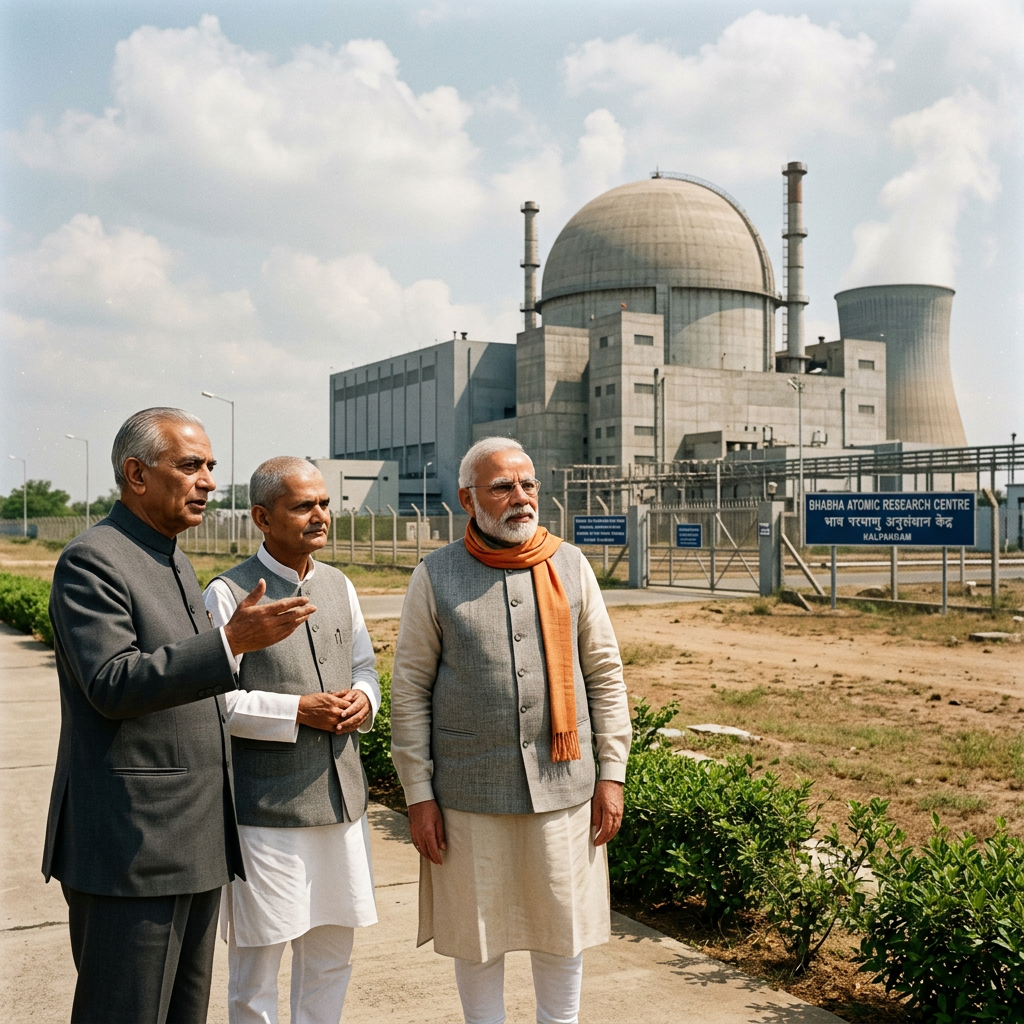
On April 6, 2026, at exactly 8:25 PM IST, a nuclear chain reaction began in a reactor at Kalpakkam, Tamil Nadu and sustained itself without any external input. In that precise moment India entered Stage 2 of a three-stage nuclear programme that Homi Jehangir Bhabha had designed in the 1950s, promised to deliver in 18 months in 1964 and died before he could see. With the world’s oil supplies under threat from the blockade of the Strait of Hormuz, with India consuming more energy than any country except China and the United States, and with a government target of 100 GW of nuclear power by 2047, the reactor at Kalpakkam is not a footnote in science news. It is one of the most consequential things to happen on Indian soil in a generation. But to understand why it matters today, you have to go back to January 1966. To a villa in Tashkent. To the Mont Blanc glacier. And to 13 days that tried to kill this story before it could even begin.
How Did Homi Bhabha Die? The 13 Days in January 1966 That Shaped India’s Nuclear History
India’s nuclear programme lost both its political patron and scientific architect within 13 days in January 1966. Both deaths remain officially unexplained. The programme they built together took 60 more years to reach Stage 2. Click any event to read the full detail.
India nuclear programme timeline: 1964 to 1974
2
Breakthroughs
4
Setbacks
5
Milestones
3
Policy shifts
2
Unresolved
OCTOBER 16, 1964
China detonates its first nuclear bomb. India’s calculation changes overnight.
Operation 596 detonates in Lop Nur, Xinjiang with a yield of 22 kilotons. Nehru had died in May 1964. His successor Shastri inherits a country humiliated by the 1962 Sino-Indian War and now facing a nuclear-armed neighbour. Bhabha immediately intensifies his argument for an Indian nuclear deterrent. The Cold War just became personal for India.
Threat catalyst
OCTOBER 1964
Bhabha on All India Radio: India can build a nuclear bomb in 18 months.
Days after China’s test, Bhabha goes on All India Radio and declares India has the capability to produce a nuclear device within 18 months if given the political go-ahead. He calls nuclear weapons “the most decisive factor in military strength.” The CIA files note this statement carefully. It is the declaration that puts a target on him.
Strategic declaration
FEBRUARY 1965
Bhabha visits Washington. Tells the CIA exactly what India can do.
Under PM Shastri’s government, Bhabha meets US Under Secretary of State George Ball in Washington and says: “If India went all out, it could produce a device in 18 months. With a US blueprint, six months.” The US refuses cooperation. The conversation goes into a State Department cable. Within a year, both Shastri and Bhabha are dead. The US State Department was still formally assessing India’s nuclear capability in March 1966 . Both men were gone.
Pivotal visit
1965
India-Pakistan war. US withholds support. India turns to the Soviet Union.
Pakistan launches Operation Gibraltar triggering the 1965 war. The US cuts military aid to both sides. India feels abandoned. The Soviet Union brokers the Tashkent peace agreement. Shastri travels to Tashkent to sign the declaration with Pakistan’s Ayub Khan . It was the last journey of his life.
Setback
13 days. Two deaths. One Cold War. January 1966.
JANUARY 11, 1966 at 1:32 AM
Lal Bahadur Shastri dies in Tashkent. No post-mortem. Questions never answered.
Hours after signing the Tashkent Declaration, Shastri wakes coughing at 1:25 AM. By 1:32 AM he is dead. Official cause: heart attack. His wife Lalita Devi says he was poisoned. His body arrives in India blue, bloated and with blood marks on his mouth, nostrils and chest. The family demands a post-mortem. The government refuses. The thermos flask he drank from is never tested. A 1977 parliamentary inquiry report into his death simply vanishes . There is no record in the Parliament Library. An RTI decades later receives the reply that one classified document cannot be released as it “would harm relations with a foreign state.” CIA officer Robert Crowley allegedly told journalist Gregory Douglas: “We nailed Shastri: he started the country’s nuclear programme in the first place.”
Unresolved (officially: heart attack)
JANUARY 24, 1966 at 7:02 AM
Homi Bhabha dies on Mont Blanc. 13 days after Shastri. No black box recovered.
Air India Flight 101, Boeing 707 named Kanchenjunga, crashes into Mont Blanc. All 117 killed. Bhabha was 56, travelling to Vienna. Official cause: pilot miscommunication with Geneva airport. The problems: the plane departed Beirut with a broken VOR receiver , a critical violation on a mountain route. No black box recovered. The crash site is within 200 metres of where another Air India flight crashed at the same location in 1950. CIA officer Crowley allegedly said: “He had an unfortunate accident. He was flying to Vienna to stir up more trouble when his Boeing 707 had a bomb go off in the cargo hold. We decided the high mountains were much better for the bits and pieces to come down on.” Wreckage continues to emerge from the Mont Blanc glacier to this day , including diplomatic cables, film reels and personal effects. The mystery has never been officially resolved.
Unresolved (officially: pilot error)
JANUARY 1966
Indira Gandhi becomes PM. The programme has no patron and no architect.
Indira Gandhi becomes India’s third Prime Minister. She inherits a nuclear programme that has lost its political champion and scientific architect in 13 days. Vikram Sarabhai, the space scientist, leads BARC and is more cautious about weaponisation than Bhabha. The nuclear weapons programme enters deliberate ambiguity. India will not test for another 8 years.
Policy shift
1967 to 1968
NPT opens for signature. India refuses. Called “discriminatory and dangerous.”
The Nuclear Non-Proliferation Treaty opens for signature in 1968. India refuses, then and for every subsequent year to the present day. India’s position: the NPT enshrines a permanent two-tier world with no credible commitment from nuclear powers to actually disarm. India will not sign a treaty that legitimises its own permanent nuclear inferiority. This refusal defines India’s relationship with the international nuclear order for six decades.
Defining refusal
DECEMBER 1971
USS Enterprise enters Bay of Bengal. Nixon sends a nuclear carrier to intimidate India.
During the 1971 war creating Bangladesh, the Nixon administration sends the USS Enterprise nuclear-powered aircraft carrier into the Bay of Bengal. India has no counter. The humiliation galvanizes Indira Gandhi’s private resolve. A senior Indian official later says: “We shall never again be in a position where a nation can intimidate us with a nuclear carrier.” The decision to test privately is made in the aftermath of 1971.
Humiliation and turning point
1972
Indira Gandhi secretly authorises “Smiling Buddha.” Raja Ramanna leads.
Gandhi gives secret authorisation to Raja Ramanna at BARC to develop a nuclear device. The project is codenamed “Smiling Buddha.” Ramanna had worked under Bhabha since 1964 and was named principal designer of India’s first nuclear device after Bhabha’s death. The programme runs with extreme secrecy , concealed even from most of the Cabinet. Gandhi tells Ramanna: “The decision to test or not to test is mine.”
Secret authorisation
1973 to MAY 1974
Preparations at Pokhran. The device is transported at 3 AM. The world does not know.
The implosion-type fission device is assembled at BARC in Mumbai and transported to Pokhran at 3 AM in an army convoy. Underground shafts are dug at the Pokhran Test Range in Rajasthan. The device is assembled on site in what scientists call the “Prayer Hall.” The army disguises preparations as military exercises. US intelligence is partially aware but is caught off guard by the final sequence.
Secret preparations
MAY 18, 1974
Pokhran-I: Smiling Buddha. India joins the nuclear club. Eight years after Bhabha promised 18 months.
India detonates an implosion-type fission device at Pokhran. Yield: 8 to 12 kilotons. PM Gandhi receives the coded message from Raja Ramanna: “The Buddha is smiling.” India describes it as a “peaceful nuclear explosion.” The world is stunned. The Nuclear Suppliers Group is formed within months specifically in response. Bhabha promised 18 months in 1964. It took 10 years. He did not live to see it. Neither did Shastri. The men who started the journey were gone. The scientists who finished it carried it in their names.
Historic breakthrough
From Pokhran to Kalpakkam to 1974 to 2026
6
Breakthroughs
5
Setbacks
9
Milestones
4
Policy shifts
1974 to 1978
NSG formed. Sanctions begin. International isolation sets in.
The Nuclear Suppliers Group is formed by 7 nuclear powers specifically in response to India’s test. Export controls on nuclear technology tighten globally. The US cuts off nuclear fuel supplies to India’s Tarapur reactors by 1978. Technology embargo hits the nuclear programme. India is effectively locked out of the international nuclear order it never signed up to via the NPT.
Setback
1982 to 1984
France fills the US gap. Kalpakkam’s first reactors go live.
France agrees to supply low-enriched uranium to India’s Tarapur reactors. BARC’s reprocessing plant at Tarapur is commissioned. In 1984, the Madras Atomic Power Station (MAPS) at Kalpakkam comes online, India’s first fully indigenous nuclear power plant. The same site where the PFBR will one day achieve criticality.
Milestone
1985
Fast Breeder Test Reactor (FBTR) goes live at Kalpakkam.
The FBTR, a small research reactor, begins operating at Kalpakkam. It is the direct scientific ancestor of the PFBR. India spends the next two decades learning liquid sodium coolant handling, fast neutron physics and closed fuel cycle technology from this reactor. Everything PFBR will need, the scientists learn here first over 40 years of operation.
Breakthrough
1987 to 1993
NPCIL established. Narora and Kakrapar commissioned. Programme expands.
NPCIL is established in 1987 to run commercial reactors. Narora Atomic Power Station (1991) becomes the first PHWR built entirely without foreign assistance. Kakrapar follows in 1993. India’s nuclear energy capacity slowly expands despite isolation, driven entirely by indigenous engineering.
Milestone
1994 to 1995
India backs down from Pokhran II under US pressure.
India plans a second round of nuclear tests. US satellites detect preparations. The Clinton administration applies intense diplomatic pressure , threatening sanctions that would cripple India’s economy. PM Narasimha Rao cancels. The tests will happen four years later under a government with a different calculation about what India can afford to lose.
Setback
MAY 11–13, 1998
Pokhran-II: Operation Shakti. India formally declares itself a nuclear weapons state.
PM Vajpayee orders five nuclear tests: a thermonuclear device, a fission device and three sub-kiloton tests. India formally declares itself a nuclear weapons state. Pakistan responds with its own tests. Major sanctions follow from the US and Japan. The Bombay Stock Exchange surges. Indian public opinion overwhelmingly backs the decision. India is in the nuclear club, outside the NPT, and has no intention of joining it.
Breakthrough
1998 to 2001
Post-Pokhran sanctions. The second isolation.
Pokhran II triggers a new wave of international sanctions from the US, Japan, Canada and others. The difference from 1974: India’s economy is larger, its diaspora more influential, and the Cold War is over. The sanctions begin to erode within three years, faster than anyone expected.
Setback
SEPTEMBER 2003
Government sanctions PFBR at Rs 3,492 crore. Target: criticality by 2010.
Financial approval for the 500 MWe Prototype Fast Breeder Reactor at Kalpakkam. Budget: Rs 3,492 crore. Target: 2010. BHAVINI is created to build and operate India’s fast breeder reactors. Nobody imagines it will take 23 more years to achieve criticality.
Policy shift
2004
PFBR construction begins at Kalpakkam.
Ground is broken for the PFBR. The reactor uses uranium-plutonium MOX fuel and liquid sodium coolant. Over 200 Indian companies including MSMEs will eventually contribute components. The liquid sodium requirement is the most technically challenging element: sodium explodes on contact with water and burns in air. The scientists are aware of every failure mode.
Milestone
JULY 2005 to OCTOBER 2008
Indo-US Nuclear Deal. India breaks out of isolation after 34 years.
PM Manmohan Singh and President George W. Bush agree on a framework for civilian nuclear cooperation. The Indo-US 123 Agreement is signed in 2008. The NSG grants India a historic waiver despite its non-NPT status. Doors open to Russia (Kudankulam), France (Jaitapur) and the US. 34 years after Pokhran-I, India is back in the international nuclear mainstream.
Policy shift
2013
Kudankulam commissioned. PFBR misses its first criticality deadline.
Kudankulam Unit 1, built with Russian assistance, is commissioned adding 1,000 MWe to India’s grid. Meanwhile the PFBR was supposed to achieve criticality this year. It does not. Technical challenges with sodium coolant systems, fuel loading and AERB safety requirements push the date back. The first of many annual delays that will continue until 2026.
Milestone
2013 to 2023
Ten years of PFBR delays. “Next year” becomes a running joke.
Every year from 2013 to 2023, the DAE announces criticality is expected “next year.” Every year it does not happen. The original budget of Rs 3,492 crore more than doubles to Rs 8,181 crore. The Parliamentary Standing Committee notes the cost overrun. The project was supposed to complete in 2010. By 2023 it is still not critical. The scientists keep working.
Setback
MARCH to JULY 2024
PM Modi at Kalpakkam. Core loading begins. AERB clears approach to criticality.
PM Modi visits Kalpakkam and initiates core loading, the process of placing nuclear fuel placed into the reactor vessel. Stage 2 of India’s three-stage programme made physically real. The AERB subsequently grants formal clearance in July 2024 for fuel loading and approach to criticality, valid until December 2026.
Milestone
OCTOBER 2025
Final fuel loading begins. Criticality weeks away.
After solving additional technical issues, AERB clears BHAVINI to begin final fuel loading in October 2025. All 181 fuel subassemblies are loaded into the reactor core over several weeks. The approach to criticality begins. India’s scientists have prepared for this moment for 40 years since the FBTR first went critical in 1985.
Milestone
DECEMBER 2025
SHANTI Bill passed. India sets 100 GW nuclear target by 2047.
Parliament passes the SHANTI Bill (Sustainable Harnessing and Advancement of Nuclear Energy for Transforming India). The Nuclear Energy Mission targets 100 GW of nuclear capacity by 2047, India’s centenary year. Current capacity: 8.78 GW at 3% of electricity mix. The ambition is a 10x expansion in two decades.
Policy shift
APRIL 6, 2026 at 8:25 PM IST
PFBR achieves first criticality at Kalpakkam. Stage 2 begins. Bhabha’s dream arrives, 60 years late.
The 500 MWe Prototype Fast Breeder Reactor at Kalpakkam achieves first criticality, the precise moment when a sustained nuclear chain reaction begins. India officially enters Stage 2 of the three-stage programme Bhabha conceived in the 1950s. India becomes only the second country after Russia to achieve commercial-scale fast breeder reactor criticality. Cost overrun: Rs 4,689 crore. Delay: 16 years. The dream Bhabha carried to Mont Blanc in January 1966 has, 60 years later, come alive at Kalpakkam. Stage 3, thorium-based reactors, is now within reach.
Historic breakthrough
Frequently Asked Questions: India Nuclear Programme History
How did Homi Bhabha die?
Homi Jehangir Bhabha, the father of India’s nuclear programme, died when Air India Flight 101, a Boeing 707 named Kanchenjunga, crashed into Mont Blanc in the French Alps on January 24, 1966 at 7:02 AM. All 117 passengers and crew were killed. Bhabha was 56 years old and was travelling to Vienna for an IAEA meeting. The official cause was pilot miscommunication with Geneva airport. However, the aircraft had departed Beirut with a broken VOR receiver, a critical safety violation on a mountain route. No black box was recovered. Former CIA officer Robert Crowley allegedly told journalist Gregory Douglas: “He had an unfortunate accident. He was flying to Vienna to stir up more trouble when his Boeing 707 had a bomb go off in the cargo hold.” The mystery has never been officially resolved. Wreckage continues to emerge from the Mont Blanc glacier to this day.
What happened to Lal Bahadur Shastri in Tashkent?
India’s second Prime Minister Lal Bahadur Shastri died in Tashkent, Uzbekistan (then the Soviet Union) at 1:32 AM on January 11, 1966, hours after signing the Tashkent Declaration ending the 1965 India-Pakistan War. The official cause was a heart attack. His wife Lalita Devi alleged he was poisoned. His body arrived in India with unexplained blood marks on his mouth, nostrils and chest, and abnormal blue colouration. The family demanded a post-mortem. The government refused. The thermos flask he drank from that night was never returned to the family and never tested. A 1977 parliamentary inquiry report into his death disappeared entirely. A subsequent RTI revealed that one classified document on the death cannot be released as it “would harm relations with a foreign state.”
Is there a connection between Shastri’s death and Bhabha’s death in 1966?
Lal Bahadur Shastri died on January 11, 1966 and Homi Bhabha died on January 24, 1966, exactly 13 days apart. Both deaths occurred outside India. Both men were central to India’s nuclear weapons ambitions: Shastri had authorised Bhabha’s nuclear work as PM, and Bhabha had publicly announced India could build a nuclear bomb in 18 months. Former CIA operative Robert Crowley allegedly confessed in a book by journalist Gregory Douglas titled “Conversations with the Crow” (2013) that the CIA eliminated both men to stop India from becoming a nuclear power. He allegedly said: “Bhabha was a genius, and he could get things done, so we aced both of them.” No independent verification of Crowley’s claims exists. Both deaths remain officially unexplained.
Did the CIA kill Homi Bhabha and Lal Bahadur Shastri?
This has never been officially confirmed by any government. The primary source for the CIA theory is the book “Conversations with the Crow” (2013) by Gregory Douglas, which documented interviews with alleged CIA officer Robert Crowley (1925 to 2000). Crowley’s credibility has been questioned by historians and intelligence researchers. However, the geopolitical motive was real: in February 1965, Bhabha had told US officials directly that India could build a nuclear bomb in 18 months, and the US was actively trying to prevent India from weaponising its nuclear programme. The PMO’s refusal to declassify documents on Shastri’s death citing potential harm to “foreign relations” has fuelled speculation. The matter remains unresolved and contested.
What is India’s three-stage nuclear power programme?
India’s three-stage nuclear power programme was conceived by Homi Bhabha in the 1950s to overcome India’s limited uranium reserves by eventually transitioning to thorium, which India possesses in abundance. Stage 1 uses Pressurised Heavy Water Reactors (PHWRs) fuelled by natural uranium, producing plutonium as a byproduct. Stage 2 uses Fast Breeder Reactors (FBRs) fuelled by plutonium, which breed more fissile material than they consume and produce uranium-233 from thorium. Stage 3 uses Advanced Heavy Water Reactors fuelled by uranium-233 and thorium at scale. India completed Stage 1 over several decades. Stage 2 officially began when the Prototype Fast Breeder Reactor (PFBR) at Kalpakkam achieved first criticality on April 6, 2026. Stage 3 is the ultimate goal, unlocking India’s 319,000 tonnes of thorium reserves, the world’s largest.
What was Operation Smiling Buddha and when did India first test a nuclear device?
Operation Smiling Buddha was the codename for India’s first nuclear weapons test, conducted on May 18, 1974 at the Pokhran Test Range in Rajasthan under Prime Minister Indira Gandhi. The implosion-type fission device produced a yield of 8 to 12 kilotons. India described it as a “peaceful nuclear explosion.” The test was designed by Raja Ramanna and his team at BARC, working from the scientific foundation Homi Bhabha had established. When PM Gandhi received the coded message from Ramanna, it read: “The Buddha is smiling.” The test led to the formation of the Nuclear Suppliers Group and the beginning of India’s nuclear isolation.
What is the PFBR at Kalpakkam and when did it achieve criticality?
The Prototype Fast Breeder Reactor (PFBR) is a 500 MWe sodium-cooled fast breeder reactor at Kalpakkam, Tamil Nadu, designed by the Indira Gandhi Centre for Atomic Research (IGCAR) and built by BHAVINI (Bharatiya Nabhikiya Vidyut Nigam Limited). It is Stage 2 of Homi Bhabha’s three-stage nuclear programme. The PFBR achieved first criticality on April 6, 2026 at 8:25 PM IST, the precise moment when a sustained nuclear chain reaction began on its own. Construction started in 2004 with a target of 2010. It was 16 years late and cost Rs 8,181 crore against an original budget of Rs 3,492 crore. India became only the second country after Russia to achieve commercial-scale fast breeder reactor criticality.
Why did India not sign the Nuclear Non-Proliferation Treaty (NPT)?
India has refused to sign the NPT since it opened for signature in 1968 and continues to refuse as of 2026. India’s stated position is that the NPT is a discriminatory treaty that enshrines a permanent two-tier international order: countries that already had nuclear weapons when the treaty was created are permitted to keep them, while all others are permanently barred. India argues that the nuclear weapons states have made no credible commitment to actual disarmament. India also argues it cannot accept a treaty that leaves it permanently exposed to nuclear-armed neighbours (China from 1964, and Pakistan later) while being legally prohibited from developing its own deterrent. India, along with Pakistan and Israel, remains outside the NPT framework.
Sources
1. The Print: Sabotage or accident? The theories about how India lost nuclear energy pioneer Homi Bhabha theprint.in
2. Curious Indian: The Lal Bahadur Shastri Death Mystery: The Tashkent File curiousindian.in
3. Diplomacy Beyond: The Conspiracy of Silence: Was Lal Bahadur Shastri Murdered? diplomacybeyond.com
4. Asianet Newsable: Conspiracy Files: The CIA blew up Homi Bhabha’s plane newsable.asianetnews.com
5. Al Jazeera: India’s nuclear leap: Why its fast breeder reactor success matters aljazeera.com
6. DD News: PFBR at Kalpakkam achieves first criticality: What it means for India’s nuclear energy plans ddnews.gov.in
7. PIB / Department of Atomic Energy: A New Chapter in India’s Nuclear Journey pib.gov.in
8. Business Today: Kalpakkam fast breeder reactor goes critical: What it means businesstoday.in
9. The Federal: India’s PFBR reaches criticality: Milestone after years of delays thefederal.com
10. Wikipedia: Pokhran-II and India’s three-stage nuclear power programme wikipedia.org
11. Wisconsin Project on Nuclear Arms Control: India Nuclear Milestones 1945 to 2018 wisconsinproject.org
Dilshad is a journalist, filmmaker and digital marketing expert covering Indian politics and elections at TNT News.
Indian news analysis that goes beyond the headline. That is what TNT News Buzz is built for.
We cover Indian politics, foreign policy, political economy, and accountability journalism for readers who want the full context. Who benefits. What the record shows. What mainstream outlets have missed.
Leave a Reply