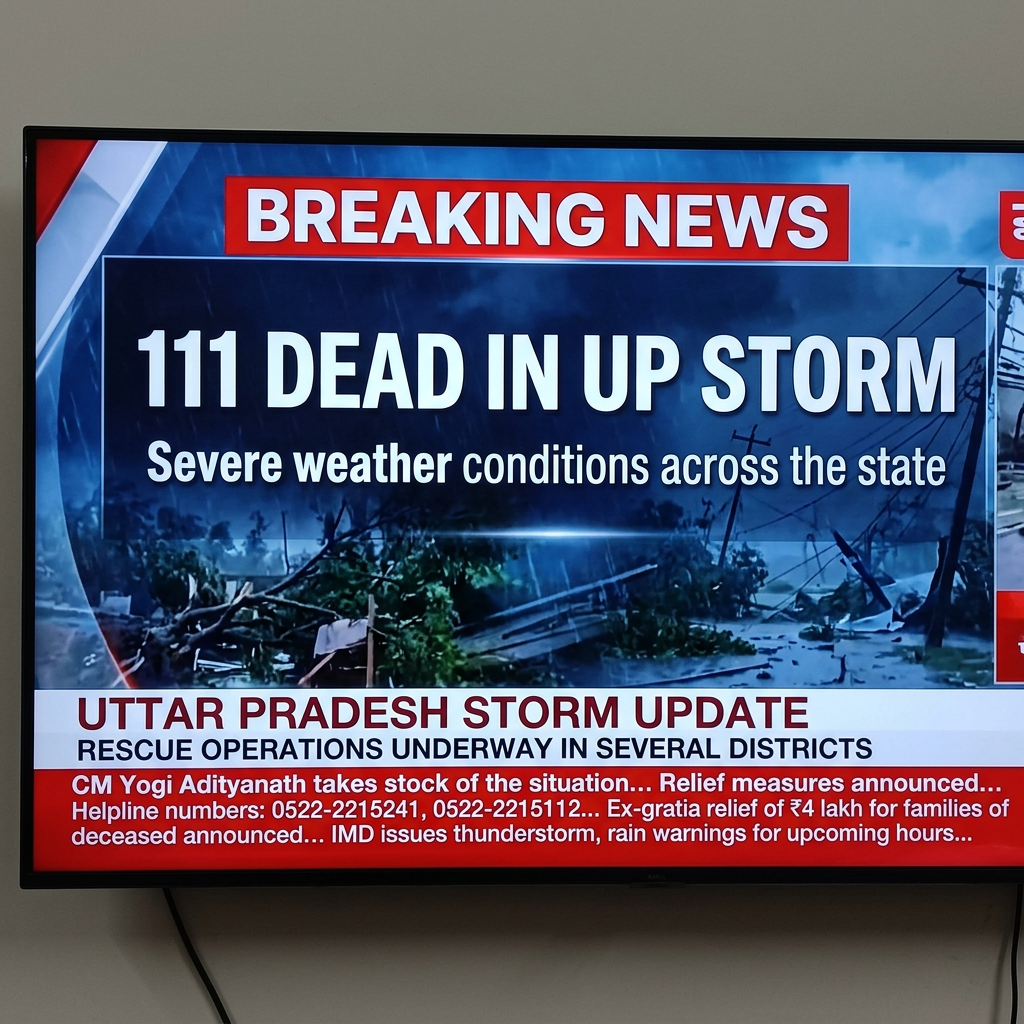
111 Dead in UP Storm. Prayagraj Has Been Top of This List for Five Consecutive Years. Here Is the Data.
Lightning deaths in Uttar Pradesh have risen every year since 2021. The same districts die every pre-monsoon season. The government response is identical every year. This is not a weather story.
111 people were killed in Uttar Pradesh on May 13, 2026, after dust storms, hailstorms and lightning struck 26 districts. Prayagraj led with 21 deaths. Lightning deaths in UP have risen every year since 2021 and have never fallen below 300 per year. Lightning has never been declared a natural disaster in India. Lightning protection systems cover 2 percent of the country. The same districts die every year.
What Happened on May 13, 2026
Dust storms, hailstorms, torrential rain and lightning struck Uttar Pradesh on the evening of May 13. The initial toll from the Relief Commissioner’s office was 89 dead. As district reports came in overnight, the number rose to 111.
The extreme weather hit at least 26 districts. Roads were blocked by fallen trees. Electric poles snapped. Mud houses and boundary walls collapsed under the impact of rain and fierce winds. Two pontoon bridges were destroyed.
In Bhadohi’s Rampur area, a pontoon bridge collapsed and several people fell into the Ganga. In Mirzapur’s Gaura Pramanpur, a second bridge collapse cut off approximately 20 villages for hours. In Bareilly, a man was filmed being lifted 50 feet into the air by gale-force winds catching a tin shed. He is hospitalised.
Children and elderly residents were among the dead. Victims included farmers, daily wage labourers, truck drivers and construction workers caught outdoors when the weather changed.
District-by-district death toll, May 13 2026
| District | Deaths |
|---|---|
| Prayagraj | 21 |
| Mirzapur | 19 |
| Sant Ravidas Nagar (Bhadohi) | 16 |
| Fatehpur | 11 |
| Unnao | 6 |
| Badaun | 6 |
| Pratapgarh | 4 |
| Bareilly | 4 |
| Sitapur, Raebareli, Chandauli, Kanpur Dehat, Hardoi, Sambhal | 2 each |
| Kaushambi, Shahjahanpur, Sonbhadra, Lakhimpur | 1 each |
The Trend Nobody Reports: UP Lightning Deaths Are Rising Every Year
Most coverage treats this week’s deaths as a single event. They are not. They are the latest point in a trend running for at least five years.
The number has increased every single year. Uttar Pradesh recorded 275 lightning deaths in 2024, making it the third worst state in India after Madhya Pradesh (577 deaths) and Bihar (360 deaths), according to CROPC’s Annual Lightning Report 2024-25.
Across India, lightning killed 2,825 people in 2024, a 10 percent increase on 2023. The six-year cumulative toll since 2018 has crossed 17,000. Lightning kills more Indians every year than floods, cyclones and heatwaves combined.
The Same Districts. Every Year.
Prayagraj reported 21 deaths this week. This is not coincidental. Prayagraj has led the UP death toll in major storm events for at least five consecutive years. The pattern is a policy failure, not a geography problem.
Who Actually Dies in These Storms
Research on Indian lightning and storm fatalities consistently shows the same victim profile. These are not people who ignored warnings. These are people who had no safe structure, no warning in time, and no protocol for what to do when the sky turned dark.
In Fatehpur, five of the eight Khaga deaths were women. They were inside their homes. Their homes were made of mud. The storm that killed them was forecast 48 hours in advance.
The Government Script, Repeated Every Year
Yogi Adityanath’s administration has responded to every major storm season in UP with the same operational template. The sequence is efficient, well-intentioned, and structurally unchanged since 2021.
The 24-hour compensation commitment is operationally genuine and materially important to bereaved families. The problem is that compensation is the only structural response that exists. There is no equivalent protocol for prevention.
Three Structural Failures Behind Every Death
The Honest Accounting
111 people died on May 13. Lightning deaths in UP have risen every year for five consecutive years. The same districts die every time. The same government response follows every time.
Lightning remains unclassified as a natural disaster. Lightning protection covers 2 percent of the country. A fifth of rural UP homes still fail under storm load. The IMD knew the storms were coming. The district collectors knew which tehsils are vulnerable. The NDMA has published the maps.
The difference between a storm that kills 10 people and a storm that kills 111 people is not the weather. It is the wall thickness, the roof material, the early warning that did or did not arrive, and the shelter that did or did not exist in the fields of Khaga tehsil on the evening of May 13.
Three of those four things are policy decisions. None of them changed between last pre-monsoon season and this one.
Frequently Asked Questions
Sources
- UP Relief Commissioner’s Office official statement, May 14, 2026
- CROPC Annual Lightning Report 2024-25, Climate Resilient Observing Systems Promotion Council
- Free Press Journal: Uttar Pradesh reports 373 lightning deaths in 2024-25 (September 2025)
- Down to Earth: Over 160 killed by lightning in March-April 2025, 184 percent surge from last year (April 2025)
- Down to Earth: Lightning an understated disaster in India (December 2025)
- CROPC via Sott.net: Lightning killed 2,825 people across India in 2024
- CEDA Ashoka University: How many Indians live in a pucca house with basic amenities (2024)
- NDMA: Protocol for early warning dissemination on thunderstorms and lightning (2021)
- AFP via Free Malaysia Today: Toll from India’s Uttar Pradesh storms rises to 111 (May 15, 2026)
- Dynamite News: UP Weather, 111 killed as hailstorms wreak havoc in 25 districts (May 14, 2026)
- Springer Nature: Lightning-related fatalities in India 1967 to 2020 (2024)
TNT News corrects errors when they are made. Write to contact@tntnews.buzz with corrections or additional data.
Dilshad is a journalist, filmmaker and digital marketing expert covering Indian politics and elections at TNT News.
Leave a Reply