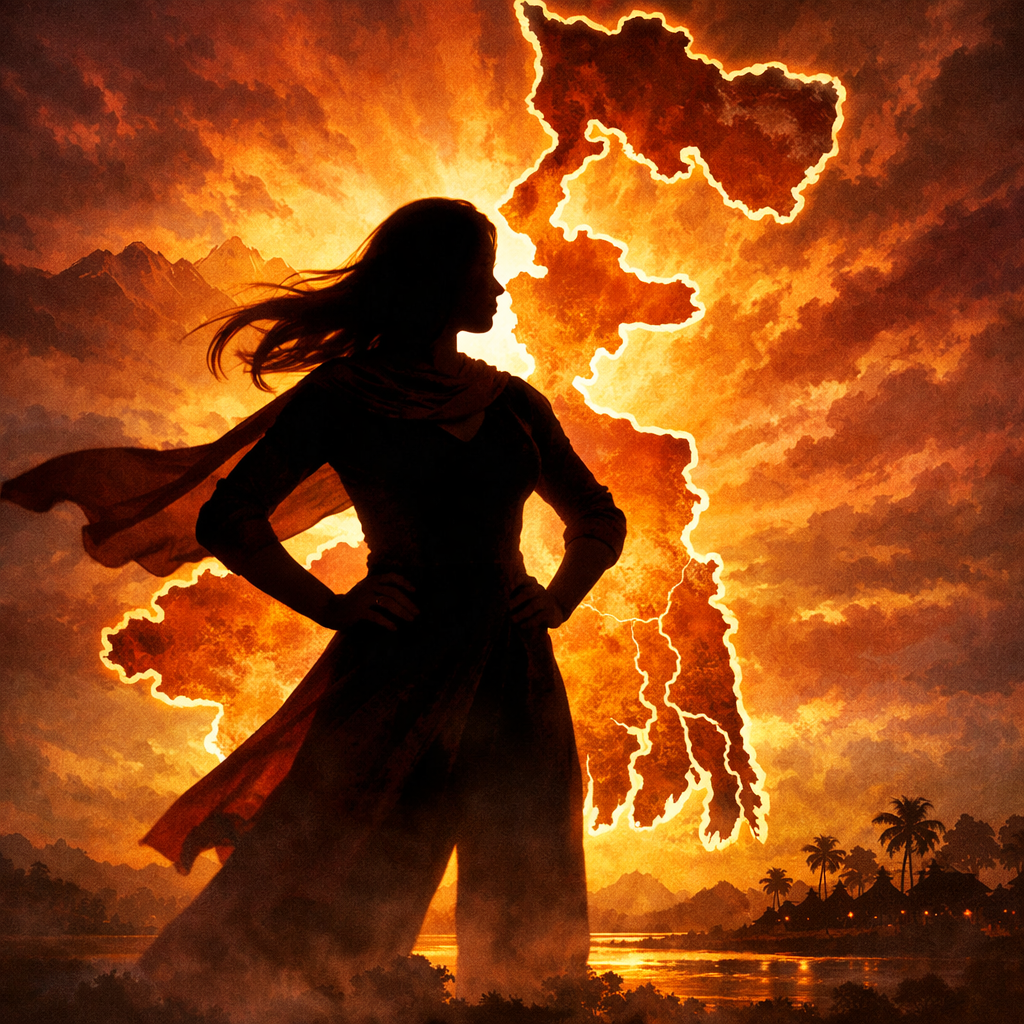
What India Lost on May 4
- India has produced exactly three self-made dominant female political forces in its post-independence history: Indira Gandhi, Jayalalithaa, and Mamata Banerjee. All three are now either dead or out of power.
- Only 10 percent of India’s MPs and MLAs are women. The country that gave the world its first female Prime Minister in 1966 has been running on empty ever since.
- The Indian opposition heading into 2029 is not just leaderless. It is leader-less in a specific way: there is no woman in it who frightens anyone.
- Every female politician currently visible at the national level either inherited her position through dynasty or holds a technocratic role inside a male-dominated party. Not one has built herself from scratch.
- India does not have a pipeline problem for female political leaders. It has a permission problem. The system produces women who support parties. It does not produce women who build them.
Let us be honest about what Mamata Banerjee’s defeat in Bengal actually costs India beyond the TMC’s seat count.
It costs India its last self-built, self-sustained, impossible-to-ignore female political force.
Indira Gandhi is dead. Jayalalithaa is dead. Mamata Banerjee just lost her assembly seat in her own constituency by 10,000 votes. The three women who defined what dominant female political leadership looks like in this country are now, collectively, gone from the stage. One of them is still alive and fighting, but she is 71 years old and leading an 82-seat opposition in a state she no longer governs.
The question the Indian political class is not asking today, because it is too uncomfortable to ask, is this: who comes next?
Three Women Who Actually Frightened People. India Has Not Produced a Fourth.
Before asking where the next one is, it is worth being precise about what the previous three actually were.
They were not simply powerful women in powerful positions. India has plenty of those. Droupadi Murmu is President. Nirmala Sitharaman controls the national budget. Smriti Irani ran multiple ministries. Sonia Gandhi presided over Congress for 19 years.
None of them frightened anyone the way Indira, Jayalalithaa, and Mamata frightened their opponents.
The distinction matters. Indira Gandhi declared an Emergency, imprisoned her opponents, fought back from a crushing defeat in 1977, and returned to power three years later with a larger mandate. She was not powerful because of her position. She was powerful because she was willing to do things no one expected her to do, and her opponents never quite knew what was coming next.
Jayalalithaa ran Tamil Nadu with an iron grip that made the Dravidian political machine, itself one of the most ruthless patronage systems in Indian politics, look like a gentlemen’s club. She was convicted of corruption, served time, was acquitted, and returned to power. She governed six times as Chief Minister. She died in office. The AIADMK has not recovered from her absence nine years later.
Mamata Banerjee walked barefoot through the streets of Kolkata to protest land acquisition. She fasted in public. She shouted at Prime Ministers in railway budget sessions. She defeated 34 years of Left rule through sustained street agitation that most political analysts said was impossible. She then held off the full weight of the BJP’s national machinery in 2021 and won 215 seats.
What these three shared was not just ambition. It was a specific quality of political fearlessness that the Indian system tends to punish in women and tolerate in men. They were uncompromising, combative, and refused to be junior partners in anyone else’s political project. They built things. They did not inherit them.
India’s Dominant Female Political Leaders: Then and Now
| Leader | How She Rose | Peak Power | Status Today |
|---|---|---|---|
| Indira Gandhi | Through Nehru dynasty, then self-built after 1969 split | Prime Minister, architect of Emergency, 1971 Bangladesh war | Died 1984 |
| Jayalalithaa | Through MGR’s shadow, then self-built AIADMK dominance | Six-time Tamil Nadu CM, national political force | Died 2016 |
| Mamata Banerjee | Entirely self-built from Congress rebel to TMC founder | Three-term Bengal CM, national opposition face | Lost power May 2026 |
| Droupadi Murmu | NDA appointment | President of India | Ceremonial head of state, not political force |
| Nirmala Sitharaman | BJP technocrat appointee | Finance Minister | Inside a male-dominated party, not independent |
| Priyanka Gandhi | Nehru-Gandhi dynasty | Congress general secretary, Wayanad MP | Yet to demonstrate independent political identity |
India Does Not Have a Women in Politics Problem. It Has a Permission Problem.
India’s women’s reservation bill, passed in 2023, promises 33 percent reservation for women in the Lok Sabha and state assemblies. It has not yet been implemented, pending delimitation. Even if it were implemented tomorrow, it would produce more women in legislatures. It would not produce another Mamata.
The reservation argument misunderstands the problem. The shortage is not of women willing to enter politics. Of India’s 4,666 MPs and MLAs, only 10 percent are women, according to the Association for Democratic Reforms. The shortage is of women who are given the space, the resources, and the party infrastructure to build independent political identities rather than serve as decorative representation of their male-led parties.
Look at the women currently visible at the national level. Priyanka Gandhi is a Nehru-Gandhi. Her political identity is inseparable from her family name. She is capable, articulate, and effective on the campaign trail. She is also, in the most important sense, not self-built. She inherited her political platform the way Indira Gandhi inherited her first entry into politics, with one crucial difference: Indira Gandhi eventually broke from her inheritance and built something that was entirely her own. Priyanka Gandhi has not yet shown that she can or will do the same.
Kanimozhi is one of the most intellectually formidable politicians in the Lok Sabha. She is a strong voice on language policy, federalism, and civil liberties. She is also, structurally, a regional figure in a Tamil Nadu that no longer has the national platform it had when DMK was the INDIA bloc’s 38-seat anchor. Her reach just got smaller on May 4.
Nirmala Sitharaman is a serious politician doing a serious job inside a party that is fundamentally not interested in producing female leaders who operate independently of the male hierarchy above them. She is powerful in the way that a very competent senior official is powerful. She is not powerful in the way that makes opposing parties lose sleep.
Smriti Irani lost her Amethi seat in the 2024 general election. The BJP did not fight particularly hard to keep her in Parliament. That tells you something about what the party’s investment in its women looks like when the going gets difficult.
The BJP Is Not Scared of a Single Woman in the Opposition Right Now. That Is a Crisis.
The BJP will go into 2029 with Narendra Modi as its face, its engine, and its entire argument for power. That is a known quantity. The opposition has spent six years trying to build a coalition around the absence of Modi rather than around the presence of anyone specific.
A ferociously uncompromising female opposition leader would change that arithmetic in ways that a male leader cannot. Not because the country is ready for its second female Prime Minister, though it may be. But because a woman who frightens the BJP in the specific way Mamata once did, who gets under their skin, who forces them to respond, who controls the emotional temperature of Indian political debate, is structurally harder for the BJP’s political machine to handle.
The BJP knows exactly how to fight male opposition leaders. It has a playbook. It has used it on Rahul Gandhi for a decade, on Arvind Kejriwal, on Akhilesh Yadav. The playbook involves a specific combination of institutional pressure, media narrative, and legal scrutiny that the party has refined into a reliable instrument.
That playbook is less effective against a woman of Mamata’s specific type. The reason BJP spent extraordinary resources in Bengal in 2019, 2021, and 2026 is that Mamata was the one opposition figure the playbook kept failing on. She absorbed everything, kept going, and turned every attack into a grievance that her voters felt personally. The BJP had to wait 15 years and eventually needed the RG Kar case, the school jobs scam, and Mamata’s own organisation’s failures to get her. A competent, ideologically flexible male opposition leader would have been finished years earlier.
India needs that quality of political fighter in its opposition right now. The vacancy is real and it is large.
Four Women Who Could Be the Next One. One of Them Just Needs to Stop Asking for Permission.
There is no obvious candidate. That is the honest answer. But here is who deserves to be watched.
Priyanka Gandhi Vadra remains the most credible possibility, but only if she demonstrates the willingness to operate independently of the Congress high command and build something beyond her family’s legacy. Her street campaign style in Uttar Pradesh in 2022 showed instincts that could, if properly developed, produce a genuinely formidable political figure. The raw material exists. The question is whether the system around her will allow it to develop.
Supriya Sule in Maharashtra has quietly built one of the most competent political operations in western India within the NCP. She is substantive, electorally durable, and has survived the extraordinary pressure of her father Sharad Pawar’s party being split by the BJP. She is not a national figure yet. She could be.
Atishi in Delhi won the Chief Ministership of Delhi in 2024 under the most difficult possible circumstances, with Arvind Kejriwal in jail and the AAP machinery under sustained pressure. She governed for months under conditions that would have finished most politicians. She is 43 years old. She is the youngest name on this list and the one with the most unrealised potential.
K.K. Shailaja in Kerala, the former Health Minister who managed the Nipah virus outbreaks with a precision that became an international case study, represents a different model entirely: technocratic governance with mass credibility. She is not a street fighter. She is something arguably more durable: a politician whose record speaks so clearly that it becomes its own political force.
None of these four is Mamata. None of them has built a party from scratch, faced down a national machinery alone, and won. The point is not to find a replacement for Mamata but to find the next version of what Mamata represented: a woman in Indian politics who does not need anyone’s permission to be exactly as formidable as she is.
India has produced that woman three times in its democratic history. The gap between the second and third was 32 years, from Jayalalithaa’s rise after MGR’s death in 1987 to Mamata’s national prominence after 2019. The country cannot afford another 32-year gap. The opposition cannot afford it. Indian democracy, which functions best when its dominant forces are genuinely contested, cannot afford it either.
The vacancy opened on May 4, 2026. The search begins now.
Frequently Asked Questions
Q1. Who are India’s most dominant female political leaders in history? Three women stand apart in post-independence India for building independent, dominant political identities: Indira Gandhi, who served as Prime Minister four times and remains the only woman to hold that office; J. Jayalalithaa, who served as Tamil Nadu Chief Minister six times and built one of India’s most formidable regional party machines; and Mamata Banerjee, who founded the Trinamool Congress from scratch, ended 34 years of Left rule in West Bengal in 2011, and held power for 15 consecutive years. All three were self-built political forces rather than beneficiaries of dynastic inheritance alone.
Q2. Why did Mamata Banerjee lose the 2026 West Bengal election? Multiple governance failures converged. The school jobs scam, in which thousands of teaching positions were allegedly sold by TMC-linked operators, eroded TMC’s welfare-state credibility throughout lengthy Calcutta High Court proceedings. The Sandeshkhali sexual harassment case damaged Mamata’s law-and-order image. The RG Kar Medical College rape and murder case in August 2024, and her government’s halting response to it, broke down her core “personally incorruptible Didi” brand. BJP’s booth-level organisational work under Suvendu Adhikari delivered decisive results in Junglemahal and north Bengal. Anti-incumbency after three consecutive terms compounded all of these factors.
Q3. Are there any emerging female political leaders in India who could become nationally dominant? Four names merit serious attention. Priyanka Gandhi Vadra has the instincts and the platform but has not yet demonstrated independence from the Congress family hierarchy. Supriya Sule in Maharashtra has built a durable regional political operation within the NCP under considerable pressure. Atishi governed Delhi as Chief Minister under extremely difficult circumstances in 2024 and represents the youngest credible candidate for national prominence. K.K. Shailaja of Kerala built a mass credibility through technocratic governance, particularly her management of Nipah virus outbreaks, that transcends conventional party politics. None of these four has yet built anything at Mamata’s scale.
Q4. What percentage of India’s elected representatives are women? According to the Association for Democratic Reforms, only 10 percent of India’s 4,666 MPs and MLAs are women. The Women’s Reservation Bill, passed in 2023, promises 33 percent reservation in the Lok Sabha and state assemblies but has not been implemented, pending delimitation. Even after implementation, reservation guarantees numbers in legislatures, not the emergence of self-built dominant female political figures.
Q5. How does India compare internationally on female political leadership? India elected its first female Prime Minister in 1966, earlier than the United States, United Kingdom (1979), Germany (2005), or New Zealand (1997). At the level of parliamentary representation, India ranks significantly lower. The Inter-Parliamentary Union ranked India 143rd globally for female parliamentary representation in recent assessments. The gap between the symbolic milestone of Indira Gandhi’s Prime Ministership and the structural reality of female representation in Indian politics is one of the widest of any democracy.
Sources
- Association for Democratic Reforms — Women’s Political Participation and Representation in India 2026 — https://adrindia.org/content/Womens-Political-Participation-and-Representation-in-India-2026
- Wikipedia — List of Female Opposition Leaders in India — https://en.wikipedia.org/wiki/List_of_female_opposition_leaders_in_India
- Zee News — Women in Politics: Female Political Forces Across States in 2026 Election Season — https://zeenews.india.com/india/women-in-politics-female-political-forces-across-states-in-2026-election-season-3021187.html
- GeeksforGeeks — List of Famous Women Politicians in India — https://www.geeksforgeeks.org/upsc/famous-women-politicians-in-india/
- Vote India — Top 25 Most Powerful Women in Indian Politics — https://www.voteindia.com/media/top-25-most-powerful-women-in-indian-politics
- TNT News — Mamata Banerjee Lost Bengal. Here Is Why That Is Good for Indian Democracy — https://tntnews.buzz/mamata-banerjee-lost-bengal-bjp-win-2026-indian-democracy/
Related Read
- TNT News — Mamata Banerjee Lost Bengal. Here Is Why That Is Good for Indian Democracy — https://tntnews.buzz/mamata-banerjee-lost-bengal-bjp-win-2026-indian-democracy/
- TNT News — Election Results 2026 Live Today: West Bengal, Tamil Nadu, Kerala, Assam and Puducherry — https://tntnews.buzz/election-results-2026-live-west-bengal-tamil-nadu-kerala-assam-puducherry-counting-today
- TNT News — Vijay Did in 26 Months What Congress Couldn’t Do in 50 Years in Tamil Nadu — https://tntnews.buzz/vijay-tvk-tamil-nadu-election-2026-winning-playbook-dravidian-duopoly/
Dilshad is a journalist, filmmaker and digital marketing expert covering Indian politics and elections at TNT News.
Leave a Reply