Quick Take:
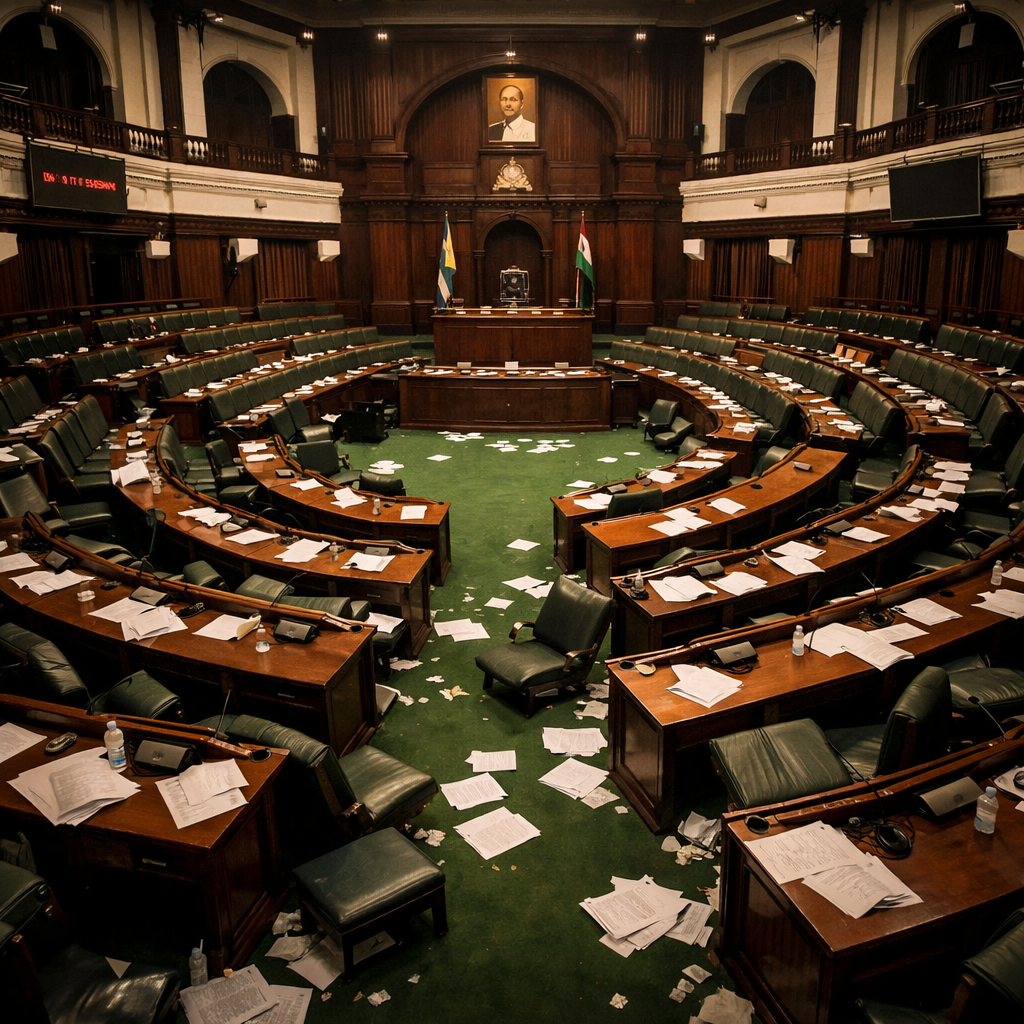
- TVK won 108 seats in its debut election. It is 10 seats short of a majority. It is also the most extraordinary political debut in Tamil Nadu’s 60-year democratic history.
- Congress spent five decades as a minor alliance partner in Tamil Nadu, never breaking through on its own. TVK is now offering Congress cabinet seats to form the next government.
- AIADMK’s slow collapse after Jayalalithaa’s death in 2016 created the vacuum. Vijay filled it before the DMK could consolidate.
- The hung assembly is not a sign of weakness. A two-year-old party that forces coalition negotiations in its debut election has already won the argument about its relevance.
- The playbook Vijay used: fan infrastructure, 70,000 booth agents, solo contest, anti-dynasty messaging, women-first promises. It is now the most studied template in Indian regional politics.
What TVK’s 108 Seats Mean
On February 2, 2024, actor Vijay stood before a crowd and announced the formation of Tamilaga Vettri Kazhagam. Tamil Nadu’s political establishment smiled. A new celebrity party. They had seen this before. They knew how it ended.
On May 4, 2026, exactly 26 months later, TVK won 108 of Tamil Nadu’s 234 assembly seats with 35 percent of the vote. MK Stalin, Tamil Nadu’s Chief Minister, lost his own Kolathur constituency to a TVK first-timer. The DMK, which governed Tamil Nadu with 159 seats five years ago, was reduced to 73. The AIADMK, the only alternative to DMK rule since 1967, won 53.
TVK fell 10 seats short of the 118 needed for an outright majority. By evening, it had offered Congress cabinet positions in exchange for support, and the Congress high command was in urgent deliberations with its Tamil Nadu unit. A party that did not exist two years ago is now negotiating to form a state government.
The political establishment was not smiling anymore.
This is not a story about a film star getting lucky. It is a story about a political operation that was more disciplined, more systematically built, and more strategically coherent than anything Tamil Nadu’s veteran parties expected from a 26-month-old organisation. The question worth answering today is not whether TVK won. It is how, and what it means.
The 60-Year Lock That Nobody Could Break
To understand the scale of what happened on May 4, you need to understand what Tamil Nadu’s political binary actually was and why it held for so long.
Since 1967, Tamil Nadu has had a simple rule: either DMK wins or AIADMK wins. One or the other. Always. The Congress, which once dominated Tamil Nadu before the Dravidian movement took hold, has not won power independently since that year. It has spent five decades as a junior coalition partner, never threatening the duopoly. The BJP has never broken into double digits in the state assembly. Regional parties like MDMK, PMK, NTK, and VCK have won seats in isolated cycles but never threatened the binary’s dominance.
Failed Attempts to Break the Duopoly
| Party | Leader | Year | Seats Won | What Went Wrong |
|---|---|---|---|---|
| DMDK | Vijayakanth | 2011 | 29 (alliance partner) | Never contested solo, remained dependent on AIADMK alliance |
| Makkal Needhi Maiam | Kamal Haasan | 2021 | 0 | No booth-level infrastructure, charisma without organisation |
| Congress | Multiple | 1967-2026 | Never independent majority | Became comfortable as junior alliance partner, stopped building ground organisation |
| NTK | Seeman | 2021 | 0 | Strong ideological base, zero tactical discipline at booth level |
The reason the binary held for 60 years is structural. Both DMK and AIADMK are not just parties. They are welfare distribution networks, community identity systems, and patronage machines built across every one of Tamil Nadu’s 234 constituencies over generations. Defeating them requires not just votes but parallel infrastructure at the booth level that takes years to build.
Everyone who tried to break the duopoly before TVK either lacked the infrastructure, depended on alliance deals that left them as junior partners, or, in Kamal Haasan’s case, had the name recognition without the ground operation. Vijay had the name recognition and built the ground operation. That is the entire story.
The Vacuum Vijay Walked Into: AIADMK After Jayalalithaa
The structural opportunity TVK exploited was created not by TVK but by AIADMK’s disintegration after Jayalalithaa’s death in December 2016.
Jayalalithaa had been AIADMK’s entire political identity. She served as Chief Minister six times. She personally commanded loyalties that transcended caste, region, and class. When she died, the party discovered it had no succession plan and no second identity. What followed was a decade of internal fragmentation that permanently weakened the only viable alternative to DMK rule.
The sequence is important. Sasikala, Jayalalithaa’s confidante, briefly tried to take the Chief Minister’s post before her conviction in a disproportionate assets case sent her to prison. A dual leadership arrangement between O. Panneerselvam (OPS) and Edappadi K. Palaniswami (EPS) ran from August 2017 until June 2022, when EPS expelled OPS and consolidated sole control. The leadership tussle split the party’s base. The Mukkulathor community votes that had been loyal to OPS fractured in multiple directions. TTV Dinakaran, Sasikala’s nephew, formed a splinter party. OPS himself contested the 2026 election on a DMK ticket after a failed attempt to rejoin the AIADMK. Multiple AIADMK members defected to DMK in the months before the election.
By 2026, the “two leaves” symbol, AIADMK’s most recognisable electoral asset, had lost the Jayalalithaa sentiment that once made it invincible. EPS tried to run on legacy and symbol loyalty. It won 53 seats. A decade of internal division had reduced Tamil Nadu’s alternate Dravidian pole from a 135-seat force in 2016 to a rump opposition.
That vacancy, between a DMK voters were fatigued with and an AIADMK that had lost its identity, is the political space TVK occupied. Vijay did not create the opportunity. He recognised it faster than anyone else and moved first.
What Vijay Built in 26 Months: The Six-Step Playbook
Step 1: Convert Fan Clubs Into a Ground Army
Vijay did not start from zero in February 2024. He started from 85,000 fan clubs spread across Tamil Nadu that had existed since 2009 under the umbrella organisation Vijay Makkal Iyakkam. Those clubs already had geographic coverage, internal hierarchies, local leadership, and the social infrastructure of regular community activity.
When TVK was formed, that infrastructure was given political direction almost overnight. The fan club network became the party’s skeletal ground organisation before a single official recruitment drive had begun. This is not unique in Tamil Nadu politics. MGR and Jayalalithaa both converted film fan networks into AIADMK political capital. What was different was the speed. TVK formalised in weeks what it took AIADMK years to build.
Crucially, Vijay Makkal Iyakkam had already demonstrated real electoral capacity. In the 2021 local body elections, the organisation contested 169 seats and won 115. That result, years before TVK existed, was the proof of concept that Vijay’s ground network was not just enthusiasm but an operational political machine.
Step 2: The 70,000 Booth Agent Drive
In February 2025, TVK announced a large-scale enrollment drive targeting 70,000 booth agents, one per polling booth across Tamil Nadu, with a restructured internal hierarchy beneath them. This is the operational detail that separates winning parties from enthusiasm projects. A party can have 35 percent vote share and lose seats if its booth agents are not present and active on counting day.
This drive happened 14 months before the election. It shows a party thinking about execution, not just mobilisation. The DMK and AIADMK both have booth committee structures built over decades. TVK replicated that architecture in a fraction of the time by targeting its existing fan club members as the recruitment pool.
Step 3: The Vikravandi Conference
On October 27, 2024, TVK held its first political conference in Vikravandi. Over 800,000 people attended. That single number put the political class on notice. The conference served multiple purposes simultaneously: it demonstrated organisational capacity, established TVK’s ideological identity as a secular socially progressive Dravidian party, and sent a signal to DMK and AIADMK that the new entrant was not a footnote.
The ideological positioning at Vikravandi was precise. Vijay described BJP as an “ideological opponent” due to its right-wing politics and DMK as a “political adversary” due to alleged corruption and dynastic politics. This triangulation was deliberate. It positioned TVK as the clean alternative to all existing forces simultaneously, taking disaffected DMK voters, anti-incumbent AIADMK voters, and first-time voters who had no prior loyalty to either party.
Step 4: Women-First Promises
On March 7, 2026, at an International Women’s Day event in Mahabalipuram, Vijay unveiled TVK’s first batch of pre-election commitments. Every announcement was women-centric.
TVK’s Women-Centric Promises: What Was Announced
| Promise | Detail |
|---|---|
| Monthly financial assistance | Direct cash transfer to women from low-income households |
| Free LPG cylinders | Subsidised cooking gas for poor families |
| Free government bus travel | All women travelling in state government buses |
| Marriage assistance | One sovereign of gold and silk sari for brides from poor families |
| Newborn welcome kit | Gold ring and welcome kit for newborns |
| Education assistance | Financial support for girl students |
| Women’s safety teams | Dedicated state-level response units |
Tamil Nadu’s female voter turnout has consistently exceeded male turnout. Women-centric welfare promises have driven Tamil Nadu election results since the Amma Canteen era under Jayalalithaa. TVK’s decision to front-load its public commitments with women’s welfare was a direct play for the demographic that decides Tamil Nadu elections. It worked.
Step 5: The Solo Contest Decision
On March 18, 2026, Vijay announced TVK would contest all 234 constituencies alone, without alliances. This was described as high risk. It was actually the only strategy that made sense.
Alliance politics in Tamil Nadu means seat-sharing arrangements that limit your footprint and make you a junior partner in someone else’s coalition. TVK’s argument was that it was a complete political alternative, not a coalition addendum. Contesting alone was the only way to test that claim, build a party organisation across every constituency, and accumulate a vote share that would define the party’s standing for future elections.
The downside risk materialised in some constituencies where TVK vote-splitting gave seats to rivals. The upside was 35 percent vote share across all 234 constituencies in a debut election and 108 seats. A solo contest converted that vote share into a position of governing strength.
Step 6: Digital-First Communication
TVK consistently bypassed Tamil Nadu’s legacy press, which was mostly hostile or dismissive, and built its narrative directly through YouTube and vernacular digital channels. Campaign videos, Vijay’s addresses, and party announcements were released first on YouTube and WhatsApp networks, where TVK’s young supporter base consumed them without editorial mediation.
This approach had two effects. It controlled the narrative on TVK’s terms rather than through journalists sceptical of celebrity politics. It also reached the first-time voter demographic, young, urban, and digital, that neither the DMK nor AIADMK was targeting with comparable precision.
Why Celebrity Politics Usually Fails: Why Vijay Succeeded
Indian politics has a long and mostly cautionary history of film stars entering politics. The failures share a single characteristic: charisma without organisation.
Celebrity Politicians in India: Outcomes
| Politician | Party | State | Debut Result | Key Reason |
|---|---|---|---|---|
| MGR | AIADMK | Tamil Nadu | Won majority (1977) | Built cadre organisation over decades before contesting |
| Jayalalithaa | AIADMK | Tamil Nadu | Won (1989) | Inherited MGR’s intact infrastructure |
| Chiranjeevi | Praja Rajyam | Andhra Pradesh | 18 seats, merged with Congress | Charisma, no booth-level infrastructure |
| Kamal Haasan | MNM | Tamil Nadu | 0 seats (2021) | No booth-level infrastructure despite high profile |
| Vijay | TVK | Tamil Nadu | 108 seats (2026) | Fan clubs converted to 70,000 booth agents before contesting |
The pattern is unambiguous. MGR and Jayalalithaa succeeded because they had organisational depth beneath the charisma. Chiranjeevi and Kamal Haasan failed because they substituted charisma for organisation. Vijay is the first politician in this generation to replicate what MGR did: systematically convert a fan base into a political machine before contesting a single seat.
The Karur crowd crush in September 2025, in which 41 people died at a TVK rally, tested this. Any other celebrity-led political movement might have collapsed under the weight of that tragedy and the subsequent CBI inquiry. TVK did not. Vijay met victims’ families personally, announced compensation, and continued the campaign. The incident exposed crowd management weaknesses but also revealed something important: the party had a constituency that stayed even when the situation became difficult. That is the definition of an organised base, not a fan following.
The Hung Assembly: Coalition Math and What Comes Next
TVK won 108 seats. It needs 118 to govern alone. The 10-seat gap is now Tamil Nadu’s most consequential political question.
Tamil Nadu Assembly: Post-Election Seat Position
| Party / Alliance | Seats Won | Notes |
|---|---|---|
| TVK | 108 | Single largest party, 10 short of majority |
| DMK alliance | 73 | Incumbent, heavily reduced from 159 in 2021 |
| AIADMK alliance | 53 | Opposition, weakened from 66 in 2021 |
| Others | 0 | NTK and smaller parties won no seats |
| Majority mark | 118 | Required to form government |
The arithmetic suggests TVK does not need an elaborate coalition. Support from Congress or a handful of smaller parties could bridge the gap without requiring TVK to cede significant political ground.
The Congress option is the most likely and most politically significant. For Congress, backing TVK is strategically rational. The party has not independently held power in Tamil Nadu since 1967. Five decades of being a DMK alliance junior partner have produced no political return. TVK is now offering Congress actual cabinet positions, something the DMK and AIADMK have historically refused to grant. The Tamil Nadu Congress unit has already sent an internal assessment to party president Mallikarjun Kharge and Rahul Gandhi, strongly recommending support for TVK to remain politically relevant in the state.
The AIADMK option is structurally complicated. Any formal arrangement with TVK would require AIADMK to distance itself from the NDA nationally, a move with significant implications for Edappadi Palaniswami’s national political positioning. Vijay has consistently positioned TVK as a democratic alternative to both major Dravidian parties, and aligning with AIADMK would dilute that identity in ways that could hurt TVK’s 2029 Lok Sabha positioning.
The BJP option is non-existent. Vijay has publicly and repeatedly described BJP as an “ideological opponent.”
The DMK 2006 precedent is worth noting here. In that election, the DMK formed a minority government with just 96 seats, well below the majority mark, and governed effectively. If coalition talks prove complicated, a TVK minority government with outside support is a historically established option in Tamil Nadu.
The coming days will determine whether Vijay can convert electoral momentum into stable governance. What is already settled is the more important question: Tamil Nadu’s 60-year duopoly is over.
What TVK Winning Means for India Beyond Tamil Nadu
Tamil Nadu sends 39 Lok Sabha members, the fourth highest of any Indian state. In 2024, the DMK alliance won 38 of 39 for the INDIA bloc in the most dominant single-state Lok Sabha performance of any alliance that election.
All 38 of those Lok Sabha seats now have a TVK state government behind them, not a DMK one. TVK controls Tamil Nadu’s state machinery, welfare distribution networks, and electoral infrastructure heading into 2029. Whether TVK contests independently in the 2029 Lok Sabha, joins a national alliance, or negotiates from state-level dominance is the most consequential open question in southern Indian politics.
For the INDIA bloc, losing DMK as a reliable 38-seat anchor is a structural problem that no amount of optimistic framing can resolve. For BJP, a TVK-governed Tamil Nadu is neither ally nor predictable opponent. It is a new variable that national coalition arithmetic has no template for.
For India’s regional politics more broadly, TVK’s playbook has just been validated at scale. The lesson for any new regional entrant is now explicit: fan infrastructure plus booth-level organisation plus solo contest plus anti-dynasty messaging plus women-first promises equals a viable path to power in a state where two parties held a duopoly for 60 years. That lesson will not go unlearned.
Frequently Asked Questions
Q1. What is TVK and when did Vijay launch it?
A. TVK stands for Tamilaga Vettri Kazhagam, meaning “Tamil Nadu Victory Party.” Actor Vijay, whose full name is C. Joseph Vijay Chandrasekhar, launched the party on February 2, 2024. The party contested the 2026 Tamil Nadu assembly election as its debut electoral outing, just 26 months after its founding.
Q2. How many seats did TVK win in the 2026 Tamil Nadu assembly election and what was its vote share?
A. TVK won 108 of Tamil Nadu’s 234 assembly seats with approximately 35 percent of the vote share in its debut election. The DMK-led alliance won 73 seats. The AIADMK-led alliance won 53 seats. The majority mark is 118. TVK is the single largest party but is 10 seats short of an outright majority and is in active coalition discussions with Congress to form the government.
Q3. Why did DMK and AIADMK lose ground simultaneously in Tamil Nadu 2026?
A. The reasons are distinct for each party. DMK accumulated five years of anti-incumbency under MK Stalin’s government: price rise, unemployment, and a perception of corruption and dynastic politics as Udhayanidhi Stalin’s prominence in the party grew. AIADMK’s weakness predates 2026. The party has been fragmenting since Jayalalithaa’s death in December 2016, with the EPS-OPS leadership split, multiple defections, and the loss of the Jayalalithaa identity that made the “two leaves” symbol invincible. Both parties weakened simultaneously, creating a vacancy that TVK filled.
Q4. Does TVK have enough seats to form a government on its own and who are its likely alliance partners?
A. No. TVK won 108 seats against the 118-seat majority mark. TVK has offered the Congress party cabinet positions in exchange for support, and back-channel discussions with smaller parties including VCK, CPI, CPI(M), and IUML are reported to be underway. A TVK-Congress arrangement is the most likely path to government formation. The DMK 2006 minority government precedent, in which DMK governed with 96 seats well below the majority, also remains an option if coalition talks prove difficult.
Q5. How did Vijay use his fan clubs to build a political party so quickly?
A. Vijay’s fan club network, approximately 85,000 clubs across Tamil Nadu under the Vijay Makkal Iyakkam umbrella, had existed since 2009 and had already demonstrated electoral capacity by winning 115 of 169 local body seats in 2021. When TVK was formed in February 2024, this network was given political direction and converted into the party’s ground organisation. In February 2025, TVK conducted a dedicated enrollment drive targeting 70,000 booth agents, one per polling booth, using the fan club network as the primary recruitment pool. This booth-level infrastructure, built 14 months before the election, is the operational foundation of TVK’s 108-seat result.
Q6. What are TVK’s key manifesto promises and how do they differ from DMK and AIADMK?
A. TVK’s most prominent promises were women-centric: monthly financial assistance, free LPG cylinders, free government bus travel, one sovereign of gold for brides from poor families, and a newborn welcome kit. Beyond welfare, TVK’s manifesto promised a drug-free state, collateral-free education and startup loans, and job assurance for youth. The ideological differentiation from DMK and AIADMK was in framing. TVK positioned its promises as governance commitments rather than patronage distribution, accompanied by anti-corruption and anti-dynasty messaging that gave the welfare promises an ethical frame the two legacy parties could not match.
Q7. Is Vijay’s political rise comparable to MGR or Jayalalithaa and what makes his case different?
A. The structural parallels with MGR are the most relevant. MGR converted his film fan base into an organised AIADMK cadre before winning power, built layered organisational structures across the state, and used a pro-poor welfare messaging framework that his screen persona had already established. Vijay replicated that model in 26 months rather than decades. The key difference is speed and context: MGR had no competing organised party structure when he broke from the DMK in 1972. Vijay broke through against two fully operational parties with 60 years of entrenched infrastructure behind them. That makes the 108-seat result, in structural terms, the more difficult achievement.
Sources
- Newswire — Tamil Nadu Election: Final Results — https://www.newswire.lk/2026/05/05/tamil-nadu-election-final-results/
- The News Minute — Tamil Nadu Hung Assembly: What Are TVK and Vijay’s Options — https://www.thenewsminute.com/tamil-nadu/tamil-nadu-hung-assembly-what-are-tvk-and-vijays-options
- The Federal — Tamil Nadu Verdict 2026: Will TVK Chief Vijay Form Government With Congress — https://thefederal.com/latest-news/tamil-nadu-verdict-2026-vijay-government-options-241749
- BIGSTORY — Ally With Vijay: TVK Offers Congress Historic Power-Sharing Deal — https://www.bigstorynetwork.com/content/ally-with-vijay-tvk-offers-congress-historic-power-sharing-deal-to-reach-majority-mark
- Wikipedia — Tamilaga Vettri Kazhagam — https://en.wikipedia.org/wiki/Tamilaga_Vettri_Kazhagam
- Wikipedia — 2026 Tamil Nadu Legislative Assembly Election — https://en.wikipedia.org/wiki/2026_Tamil_Nadu_Legislative_Assembly_election
- Wikipedia — AIADMK-led Alliance — https://en.wikipedia.org/wiki/AIADMK-led_Alliance
- The South First — TVK Breaks Dravidian Parties Duopoly — https://thesouthfirst.com/tamilnadu/hold-tamil-nadu-assembly-elections-2026-results-live-dmk-aiadmk-and-tvk-ride-on-high-hopes/
- Election Commission of India — Live Results — https://results.eci.gov.in
Related Read
- TNT News — Election Results 2026 Live Today: West Bengal, Tamil Nadu, Kerala, Assam and Puducherry — https://tntnews.buzz/election-results-2026-live-west-bengal-tamil-nadu-kerala-assam-puducherry-counting-today
- TNT News — Tamil Nadu Election Result 2026: DMK, AIADMK, TVK Exit Polls and Key Seats — https://tntnews.buzz/2026/05/01/tamil-nadu-election-result-2026-dmk-aiadmk-tvk-vijay-exit-polls-key-seats-may-4/
- TNT News — Mamata Banerjee Lost Bengal. Here Is Why That Is Good for Indian Democracy — https://tntnews.buzz/mamata-banerjee-lost-bengal-bjp-win-2026-indian-democracy/
Dilshad is a journalist, filmmaker and digital marketing expert covering Indian politics and elections at TNT News.
Leave a Reply