Quick Contrarian Take:
- India’s strongest regional opposition voice is now free of the one thing that was weakening her: power.
- For 15 years, Mamata Banerjee had to protect her government. She no longer does. That makes her more dangerous, not less.
- BJP now governs West Bengal. Every large Indian state needs a fierce opposition. Mamata is exactly that.
- The leaders who wrote Mamata’s obituary in 2019 were wrong. The leaders writing it today are likely wrong again.
- A democracy where dominant parties lose power peacefully is a healthy democracy. May 4 proved that Bengal’s still works.
Why Mamata Losing Is Good for Democracy
The instinct, when a dominant political figure loses power after 15 years, is to write an obituary. Declare her finished. Say Bengal has moved on. That instinct is wrong, and understanding why tells you more about Indian democracy than the result itself does.
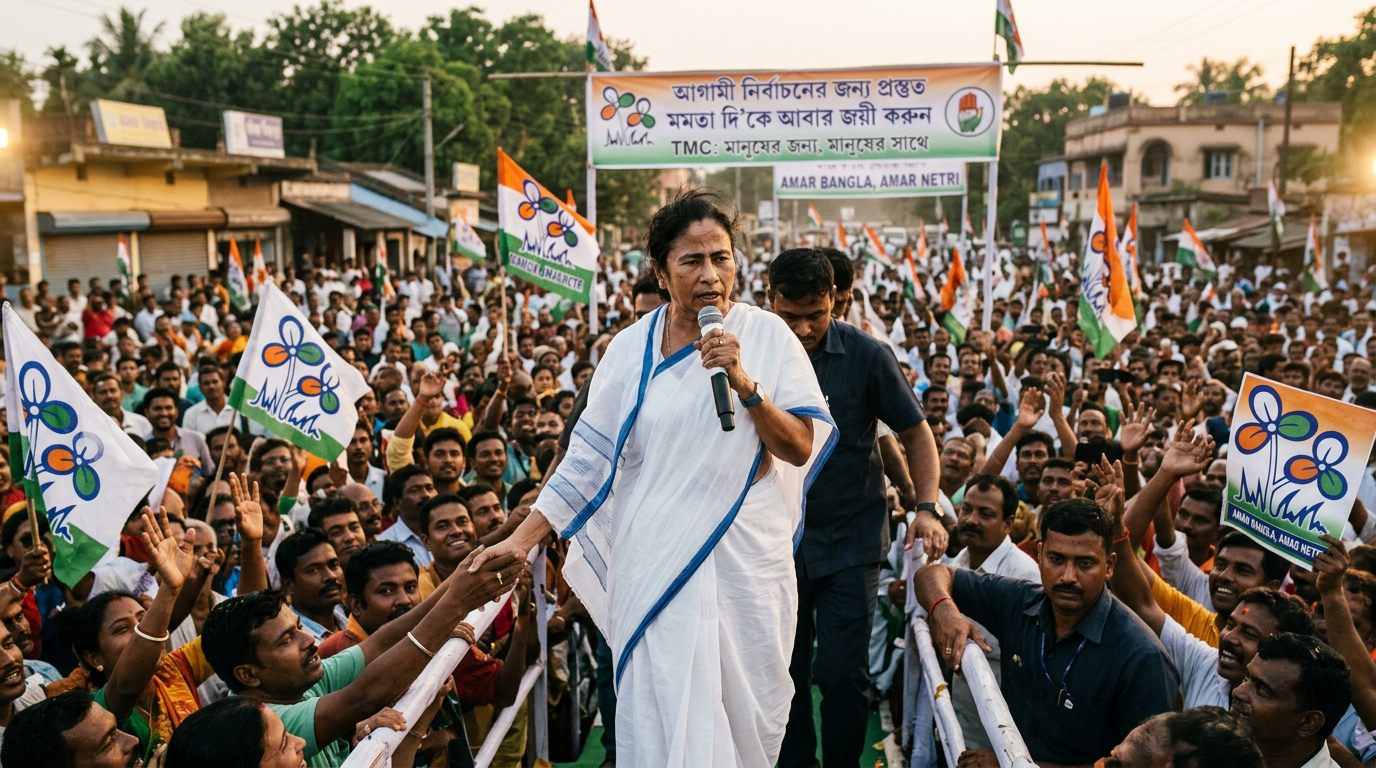
BJP’s 206-seat mandate in West Bengal is historic. It ends one of the longest unbroken single-party runs in Indian state politics outside the Left Front era. It places Bengal inside BJP’s governing footprint for the first time. And it returns Mamata Banerjee to the role she held before 2011: opposition fighter, street agitator, and relentless disruptor of whoever holds entrenched power.
India needs that Mamata back. Not out of sympathy, and not because the BJP’s win is illegitimate. But because the version of Mamata that built a career out of resistance is structurally more valuable to Indian democratic health than the version that spent 15 years accumulating power and gradually becoming the machine she once fought.
This is the story of how she fell, why it matters, and what happens next.
The Fall of Bhabanipur: What Mamata’s Seat Loss Actually Means
Mamata Banerjee did not merely lose the West Bengal election. She lost her own legislative assembly seat, to Suvendu Adhikari, by over 10,000 votes in her home constituency of Bhabanipur, south Kolkata.
In 2021, Adhikari beat her in Nandigram by 1,956 votes in a result so close it went to court. That loss was absorbed because TMC won 215 of 294 seats. Mamata won a Bhabanipur by-election months later, reclaimed her seat, and continued governing without missing a step. The political class concluded she was untouchable in her home turf.
On May 4, 2026, Adhikari removed that floor entirely. Bhabanipur is not unfamiliar ground or a political gamble. It is the constituency where Mamata has built her identity since 2011, with her full voter machinery deployed. Losing it by 10,000 votes is not a blip. It is a verdict.
The 2021 and 2026 defeats are categorically different. One was a narrow loss on contested ground. The other is a decisive loss at home. No legal challenge follows a 10,000-vote margin. No by-election saves a Chief Minister whose party has just lost 200 seats. This is a definitive break, not a chapter in an ongoing comeback story.
How TMC Lost Bengal: Five Reasons, Not One
There is no single cause for a 206-seat loss. Blaming anti-incumbency alone is too convenient, and crediting BJP’s organisation alone is too generous. Both things are true, and so are the specific failures that made TMC vulnerable in the first place.
Governance Failures That Eroded TMC’s Credibility
| Incident | Period | Why It Mattered |
|---|---|---|
| School Jobs Scam | 2022–2025 | Thousands of teaching positions allegedly sold by TMC-linked operators. Calcutta High Court proceedings ran through the entire campaign cycle. For a party whose pitch was welfare delivery, allegations that government jobs were for sale were uniquely damaging. |
| Sandeshkhali | 2023–2024 | Sexual harassment and land-grab allegations against TMC leader Sheikh Shahjahan. His months-long evasion of arrest exposed the limits of Mamata’s “I didn’t know” defence in front of national media. |
| Amphan Relief Misappropriation | 2020–2026 | Cyclone relief funds allegedly routed through TMC party machinery. BJP campaigned on this for six years. By 2026, the compounding effect had broken down Mamata’s separation from her party’s conduct. |
| RG Kar Rape and Murder Case | August 2024 | The state government’s halting response to the rape and murder of a trainee doctor at RG Kar Medical College triggered mass protests. The incident eroded Mamata’s core brand: personal incorruptibility. |
Reason 1: TMC became the machine it once fought. The party’s local networks, built on patronage and political loyalty, were the same networks accused of corruption, syndicate operations, and intimidation. Mamata could protect her own image only so long as voters were willing to separate the leader from the organisation. In 2026, they stopped.
Reason 2: BJP’s booth-level work paid off. Under Suvendu Adhikari, BJP built constituency-level ground infrastructure across north and south Bengal that had eluded it in previous cycles. In Junglemahal, the party led in 38 of 40 seats. The Kurmi Adivasi community, over 30 percent of the electorate in the region, backed BJP decisively after the Kurmi Samaj called on voters not to support TMC.
Reason 3: The minority vote fragmented. TMC’s implicit strategy was to secure Muslim bloc support through welfare delivery while retaining Hindu swing voters through Mamata’s personal appeal. By 2026, that balance broke. BJP’s SIR framing consolidated Hindu identity in constituencies where it had previously been diffuse. In some Muslim-majority districts, fragmentation toward the Left-Congress coalition reduced TMC’s winning margins in seats it held comfortably in 2021.
Reason 4: Fifteen years is a long time. Anti-incumbency after three consecutive terms is a mathematical reality in Indian state politics. Every grievance accumulates. Every local TMC functionary who misused authority over 15 years added one more voter to the column BJP was building.
Reason 5: Suvendu Adhikari. This point gets underweighted in national analysis. Adhikari is the man who built BJP’s Bengal ground operation from inside TMC’s own playbook, who knows where every booth-level weakness in the party’s structure lies, and who has now beaten Mamata personally twice. He is the architect of this result in a way that cannot be reduced to Modi wave or BJP money.
The Mamata Paradox: What Bengal Voters Knew That Delhi Ignored
Outside Bengal, Mamata Banerjee was celebrated as the most effective frontline opponent of BJP’s national dominance. She defeated BJP in the 2019 Bengal Lok Sabha seats when every other state swung toward Modi. She won a landslide in 2021 despite what she described as the full weight of central government resources against her. For the national English-language commentariat, she was the proof that regional leaders could hold Modi’s party at bay.
Bengal voters always saw a different version.
The TMC that governed Bengal was accused of controlling the state’s contract economy through syndicate networks, of political violence in panchayat elections, and of treating press criticism as BJP-engineered conspiracy. Mamata’s governance record in Bengal and her national reputation as a liberal icon were two almost entirely separate public personas maintained for two entirely different audiences.
Vir Sanghvi captured this in The Print after the results: Mamata was celebrated nationally as a liberal heroine while ruling Bengal with what he described as corruption and thuggery. The verdict on May 4 was Bengal voters saying, clearly, that the national image no longer covered for the local reality.
This is not unique to Mamata. Many of India’s most celebrated regional leaders have governed their home states with authoritarian tendencies their national profiles obscured. The 2026 result is a reminder that state elections are assessments of local governance. Eventually, local governance has to account for itself.
Why a Defeated Mamata Is Good for Indian Democracy
Consider the argument that most outlets are not making today: India’s democratic health is better served by Mamata Banerjee in opposition than by Mamata Banerjee in power.
The historical parallel that matters here is Indira Gandhi in 1977. The Emergency and the Janata Party’s landslide appeared, in the moment, to be the end of her political career. She lost her own Lok Sabha seat in Rae Bareli. Her party fell from 352 seats to 154. The obituaries were extensive and confident.
The Janata government collapsed under its own internal contradictions. Indira Gandhi spent three years rebuilding from the ground up, travelling to constituencies where her party had been wiped out, listening in a way that incumbency had made unnecessary. She returned to power in 1980 as a sharper, more strategically disciplined political force than the one who had declared the Emergency in 1975. The defeat improved her.
Fallen Regional Leaders: How They Rebuilt
| Leader | State | Year Lost | Comeback | What Happened |
|---|---|---|---|---|
| Indira Gandhi | National | 1977 | Yes | Lost her own Lok Sabha seat. Party fell from 352 to 154 seats. Returned as Prime Minister in 1980 after rebuilding from scratch over three years. |
| Chandrababu Naidu | Andhra Pradesh | 2004 | Yes | Lost power decisively after 9 years as CM. Rebuilt TDP from opposition over a decade. Returned as Chief Minister in 2014. |
| Akhilesh Yadav | Uttar Pradesh | 2017 | Ongoing | SP routed by BJP in 2017. Akhilesh rebuilt the party’s urban base and remains the most credible UP opposition figure seven years later. |
| Left Front | West Bengal | 2011 | No | Lost after 34 years in power with no opposition muscle left. Has not recovered in 15 years. The cautionary tale, not the template. |
| Mamata Banerjee | West Bengal | 2026 | Unknown | Lost 206 seats to BJP after 15 years. Lok Sabha bloc intact. Track record of comebacks stronger than any leader on this list. Next test: 2031. |
The Left Front comparison is the cautionary tale, not the template. The CPM collapsed in 2011 because it had no opposition muscle left after decades as an unchallenged governing force. TMC’s organisational memory, Mamata’s personal voter base, and her track record of comebacks make that outcome unlikely to repeat.
The democratic health argument goes beyond her individual resilience. BJP now governs the majority of India’s largest states. The national opposition is fragmented and without a clear leader. A Mamata unencumbered by administrative responsibility, free to campaign nationally and with genuine grievance against BJP’s Bengal conduct, becomes a qualitatively different kind of opposition voice. The BJP now needs someone who will make governing Bengal difficult. That is not a flaw in democracy. That is democracy functioning correctly.
What Comes Next: TMC’s Rebuild and the Opposition Playbook
TMC’s immediate task is holding together as a coherent opposition bloc with 82 assembly seats. That is not a collapse. It is a viable opposition capable of scrutinising a BJP government that will face its own governance tests in one of India’s most politically complex states.
Mamata’s Opposition Playbook: What to Expect
- Street mobilisation. Before 2011, Mamata built her entire political identity through sustained agitation against entrenched power. Expect sustained public campaigns against BJP’s Bengal governance within weeks, not months.
- Central-state confrontation. TMC will contest every central government intervention in Bengal, from CAA implementation to fiscal transfers, in the legislature, in the courts, and on the street.
- Rehabilitation of the Didi brand. The school jobs scam, Sandeshkhali, and Amphan belong to a government. In opposition, those become historical events rather than active liabilities.
- National coalition positioning. A non-CM Mamata is more available as a national INDIA bloc figure, without a state government to protect and with more incentive to be a consistent national campaigner.
The internal succession question is real. Abhishek Banerjee, Mamata’s nephew and TMC’s general secretary, built his authority within the party through access to state power. Without that, his position is harder to sustain. The next six months will reveal whether TMC can hold its structure together without the binding force of incumbency.
The 2031 Bengal assembly election is the target. BJP, having won Bengal on anti-incumbency, will now have to build its own governance record. Bengal has a near-perfect historical record of demolishing parties that hold power too long. BJP’s 206 seats feel permanent today. They will not feel permanent in 2031.
Bengal’s Result and What It Signals for Indian Federalism
BJP now governs West Bengal alongside the majority of India’s largest states. The implications for Indian federalism deserve a serious discussion that most election coverage skips.
Healthy federalism requires opposition-controlled states to exist as counterweights to central power. Bengal has been one of the most consequential counterweights. TMC’s refusal to implement CAA in West Bengal was not only a political stance. It was a federal position that forced the central government to acknowledge the limits of its ability to implement contested legislation in states with resistant governments. A BJP-governed Bengal removes that resistance. CAA implementation in the state becomes operationally straightforward for the first time since the legislation passed.
What concentration of state-level power means for Indian federalism in the long run is a question that extends beyond this election. It is also a question that a rebuilding TMC and a fragmented national opposition have every political incentive to make central to the 2029 Lok Sabha campaign.
Frequently Asked Questions
Q1. Why did Mamata Banerjee lose the 2026 West Bengal assembly election after 15 years in power? Five factors converged. The school jobs scam, with Calcutta High Court proceedings running through the entire campaign, eroded TMC’s welfare-state credibility. The Sandeshkhali case damaged Mamata’s law-and-order image. The RG Kar rape case in August 2024 broke down her personal incorruptibility brand. BJP’s booth-level organisation and Adivasi community outreach in Junglemahal delivered 38 of 40 seats in the region. And anti-incumbency after three consecutive terms compounded all of the above into a wave rather than a swing.
Q2. What happened in Bhabanipur and why is Mamata’s seat loss there significant? Mamata Banerjee lost Bhabanipur, her south Kolkata home constituency, to Suvendu Adhikari by over 10,000 votes. This is her second consecutive personal defeat to Adhikari, after he beat her in Nandigram in 2021 by 1,956 votes. The Bhabanipur result is a decisive loss on her own turf with her full voter machinery deployed, not a narrow loss on contested ground.
Q3. How many seats did BJP win in West Bengal 2026 and what was TMC’s final tally? BJP won 206 of 294 West Bengal assembly constituencies, excluding Falta where a repoll is scheduled for May 21, 2026. TMC won approximately 82 seats. The majority mark is 148. BJP’s 206-seat mandate ends 15 consecutive years of Trinamool Congress rule.
Q4. What did Mamata Banerjee say after losing the election? Mamata conceded defeat while alleging that BJP looted more than 100 seats through electoral malpractice and ECI complicity. She stated TMC would bounce back. Rahul Gandhi and Akhilesh Yadav backed her allegations. This posture will likely shape TMC’s legislative strategy in the coming months.
Q5. Is Mamata Banerjee’s political career over after losing Bengal? Her track record makes that conclusion premature. She ended 34 years of Left rule in 2011 after decades in opposition. She rebuilt TMC after BJP won 18 of 42 Bengal Lok Sabha seats in 2019, then won 215 assembly seats two years later. The closest historical parallel is Indira Gandhi’s 1977 defeat. Gandhi returned as Prime Minister in 1980. Mamata at 71, with TMC’s Lok Sabha bloc intact, is positioned to remain a significant political force through at least 2031.
Q6. What does TMC’s Bengal defeat mean for the INDIA alliance and the national opposition? TMC without a state government loses the infrastructure that allowed it to defend 29 of Bengal’s 42 Lok Sabha seats in 2024. For the INDIA bloc, a non-CM Mamata is potentially more available as a national campaign figure, without administrative constraints and with genuine grievance against BJP’s Bengal conduct.
Q7. How does Mamata Banerjee’s defeat compare to other major regional leader losses in India? The most instructive comparisons are Indira Gandhi in 1977, Chandrababu Naidu in Andhra Pradesh in 2004, and Akhilesh Yadav in Uttar Pradesh in 2017. All three were written off and returned to electoral relevance. The Left Front in Bengal is the cautionary counter-example: it lost in 2011 with no opposition muscle and has not recovered in 15 years.
Sources
- The Federal — https://thefederal.com/elections-2026/west-bengal-elections-2026-mamata-banerjee-loses-power-after-15-years-241712
- The Print — https://theprint.in
- DNA India — https://www.dnaindia.com/india/report-west-bengal-election-results-2026-mamata-banerjee-concedes-defeat-after-trailing-suvendhu-adhikari-claims-tmc-will-bounce-back-bjp-pm-modi-3209025
- Republic World — https://www.republicworld.com/elections/west-bengal-assembly-election-results-2026-live-updates
- Al Jazeera — https://www.aljazeera.com/news/2026/5/4/india-loses-its-last-left-wing-government-after-five-decades
- Election Commission of India — https://results.eci.gov.in
- Wikipedia — https://en.wikipedia.org/wiki/Mamata_Banerjee
Related Read
- TNT News — Election Results 2026 Live Today — https://tntnews.buzz/election-results-2026-live-west-bengal-tamil-nadu-kerala-assam-puducherry-counting-today
- TNT News — West Bengal Election Result 2026 — https://tntnews.buzz/2026/05/01/west-bengal-election-result-2026-counting-date-the-100-seat-pollster-gap-key-seats-and-how-to-watch-live-on-may-4/
- TNT News — Tamil Nadu Election Result 2026 — https://tntnews.buzz/2026/05/01/tamil-nadu-election-result-2026-dmk-aiadmk-tvk-vijay-exit-polls-key-seats-may-4/
Dilshad is a journalist, filmmaker and digital marketing expert covering Indian politics and elections at TNT News.
Leave a Reply