Analysis: West Bengal elections 2026
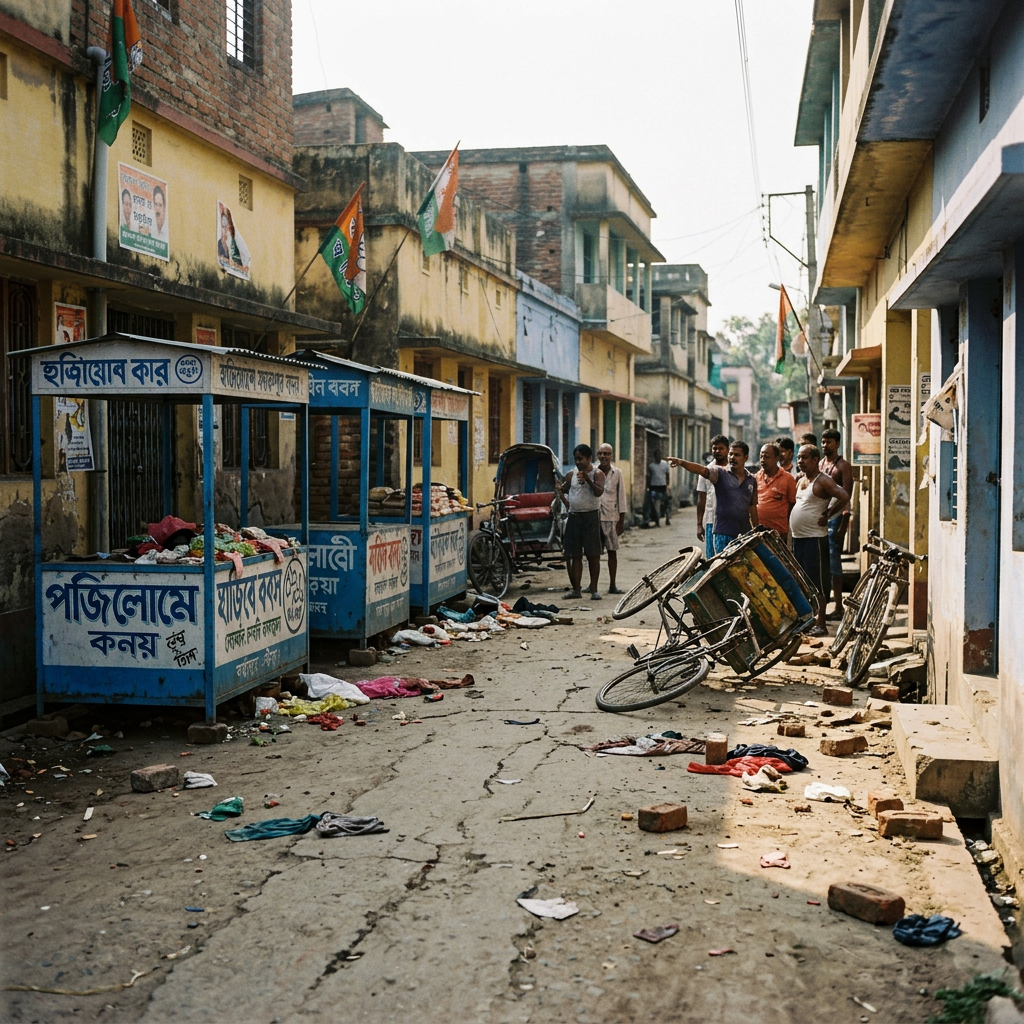
Post-poll violence has broken out in West Bengal after BJP’s historic win on May 4, 2026. At least 4 are dead. But Bengal has buried its dead after every election since 2011 regardless of who won. Here is the pattern nobody talks about.
4+
Confirmed deaths since May 4
77+
Deaths in Bengal poll violence 2011 to 2021
6+
Districts affected so far in 2026
~20
Average political murders per year in Bengal 1999 to 2016
What is Bengal post-poll violence?
Post-poll violence in West Bengal refers to politically motivated attacks on party workers, their families and offices that occur in the days and weeks after election results. It is a documented, recurring pattern that has taken place after every major election in Bengal since at least 2011, regardless of which party wins or loses.
Both BJP and TMC are claiming their workers were killed and their offices attacked. Police have not confirmed political motives in any case. All accounts below are attributed to named sources — family members, party sources or police statements. The TNT News editorial position is that violence is wrong regardless of political affiliation.
How many people have died in Bengal election violence since 2011?
At least 77 people have died in West Bengal election-related violence from 2011 to 2021, according to Logically Facts. Between 1999 and 2016, Bengal averaged approximately 20 political murders every year, according to Reuters. The table below covers every major election cycle.
| Election | Year | Deaths reported | Who won | Verdict |
| Assembly elections | 2011 | Multiple | TMC ended 34 years of Left rule |
CPM workers attacked |
| Panchayat elections | 2013 | 39 | TMC dominated |
Opposition workers attacked |
| Lok Sabha elections | 2014 | 7 in Bengal | BJP nationally, TMC held Bengal |
Multiple parties |
| Assembly elections | 2016 | Multiple | TMC second term |
CPI(M) workers attacked |
| Panchayat elections | 2018 | 13 | TMC (34% seats won uncontested) |
Opposition workers attacked |
| Lok Sabha elections | 2019 | 15 | BJP nationally, TMC won Bengal |
Both BJP and TMC workers |
| Assembly elections | 2021 | 16 to 25 | TMC third term |
BJP workers primarily |
| Assembly elections | 2026 | 4+ (ongoing) | BJP — first ever state win |
Both BJP and TMC workers |
The pattern is consistent across every row: violence follows every election cycle in Bengal regardless of which party wins or loses. The Left Front did it during 34 years of rule. TMC did it when they took over in 2011 and every election since. The party changes. The mechanism does not.
What is happening in Bengal right now? Confirmed deaths and districts
Four deaths have been confirmed by police since results were declared on May 4. Political motives have not been confirmed in any case. Here is what is known so far, with sources.
May 4
Chandranath Rath shot dead in Madhyamgram BJP worker
Personal aide to Suvendu Adhikari. Motorcycle-borne assailants opened fire near his residence. Police suspect at least 8 helmeted attackers. Rath’s driver Buddhadev Bera also shot, underwent surgery.
Source: Organiser, West Bengal DGP statement
May 5
Madhu Mondal beaten in New Town victory procession BJP worker
Beaten during what BJP described as a victory procession. Died from injuries. TMC denies involvement.
Source: PTI
May 5
Abir Sheikh killed in Birbhum’s Nanur TMC worker
Family blames BJP supporters. BJP denies involvement.
Source: The Wire
May 5
Bishwajit Pattnaik found injured in Beliaghata, Kolkata TMC worker
Found with serious injuries outside his home. Family alleges murder by BJP supporters. Died from injuries.
Source: Hindustan Times
May 6
Rohit Roy shot in Basirhat BJP worker
Shot in the abdomen during a dispute over BJP flag placement in Gotra area. Hospitalised in critical condition. BJP accused “TMC-sheltered miscreants.”
Source: Organiser
Districts affected
Birbhum
Deaths, clashes reported in Nanur
South 24 Parganas
TMC offices attacked in Diamond Harbour and Falta
North 24 Parganas
Shooting in Basirhat and Madhyamgram
Howrah
Clashes and vandalism reported
Nadia
TMC offices ransacked
Bankura
Isolated deaths and vandalism
TMC offices also reportedly ransacked in Panihati (North 24 Parganas), Ghatal (Paschim Medinipur), Asansol (Paschim Bardhaman), according to Hindustan Times. Violence also reported in Kolkata’s Beliaghata and Topsia-Tiljala areas.
Why does Bengal post-poll violence happen? The structural reason
Bengal post-poll violence is driven primarily by territorial control rather than revenge, according to political analysts and academic research. In Bengal’s political model, party cadres control access to government scheme benefits, housing allotments and public works contracts at the booth level. When power shifts, the winning party’s cadres move to take territorial control from the losing side. Violence is the enforcement mechanism for this economic capture.
In Bengal’s political ecosystem, controlling a local area means controlling who gets government scheme benefits, who gets housing allotments, who gets public works contracts, who gets day labour on government projects. Party cadres at the booth level are not just political workers. They are gatekeepers to economic access for ordinary people.
When power shifts at the state level, the new ruling party’s cadres move to establish physical presence in areas previously controlled by the outgoing party. Violence is how that transition is enforced — not an emotional reaction to election results, but an economic capture operation.
This is why the violence is geographically concentrated in areas where the local balance of power was contested. It targets booth-level workers, not senior leaders. It follows the same district-by-district pattern every cycle regardless of which party is doing it. The Left Front did this during 34 years of rule. TMC did it from 2011 onward. The BJP is accused of doing it now.
How does 2026 compare to 2021?
| Factor | 2021 | 2026 |
|---|
| Who won |
TMC (third consecutive term) |
BJP — first ever Bengal state win |
| Who lost |
BJP (reduced to opposition) |
TMC (reduced to ~80 seats from 215) |
| Deaths in first 48 hours |
6 confirmed per Reuters |
4+ confirmed |
| Final death toll (weeks later) |
16 to 25 per Call for Justice report |
Unknown — developing |
| Districts affected |
16 of 26 at peak |
6+ confirmed so far |
| Central forces retained |
Yes — eventually deployed |
500 CAPF companies retained by ECI |
| Supreme Court involvement |
CBI probe ordered later |
SC declined urgent hearing (May 6) |
| Scale of power shift |
Moderate — TMC retained power |
Large — complete change of ruling party for first time since 1977 |
In 2021, the Call for Justice fact-finding committee headed by former Chief Justice of Sikkim High Court Justice Permod Kohli found 25 people killed, 15,000 incidents of violence and 7,000 women affected across 16 of 26 districts. People fled into Assam, Jharkhand and Odisha. Whether 2026 reaches that scale depends on the next two to four weeks, which is historically the peak window for Bengal post-poll violence.
What is the government and courts doing?
ECI action: The Election Commission of India has directed West Bengal officials to enforce “zero tolerance” on post-poll violence and retained approximately 500 companies of Central Armed Police Forces in the state until further orders, according to All India Radio. Over 2,400 CAPF companies had been deployed during the election itself.
Supreme Court: The SC refused to entertain an urgent hearing on a plea seeking continuation of central forces in Bengal, ruling it was a decision for the political executive, according to The Wire.
Mamata Banerjee: Refusing to resign as Chief Minister despite losing the election, Banerjee announced she would move the Supreme Court over the post-poll violence and told party MLAs: “Let them dismiss me. I want this to be a black day.”
The pattern in plain language
Bengal has buried its dead after every election since at least 2011. Left Front workers died when TMC took over. BJP workers died when TMC won in 2021. Now both sides are losing workers as BJP takes over in 2026. The violence is not a partisan aberration. It is a structural feature of Bengal’s political model in which controlling a neighbourhood means controlling economic access. Until that model changes, the pattern will not.
Frequently asked questions
How many people have died in Bengal post-poll violence 2026?
At least 4 deaths have been confirmed by police as of May 8, 2026, according to Al Jazeera and The Wire. Police have not confirmed political motives in any case. The number is expected to rise as reports from more districts come in over the coming days.
Is Bengal post-poll violence a new problem?
No. At least 77 people died in Bengal election-related violence from 2011 to 2021, according to Logically Facts. Between 1999 and 2016, Bengal averaged approximately 20 political murders every year, according to Reuters. The pattern is documented under Left Front rule, TMC rule and now the transition to BJP.
Why does post-poll violence keep happening in Bengal?
The primary reason is territorial control, not revenge. In Bengal’s political model, controlling a local area means controlling access to government scheme benefits, housing allotments and public contracts at the booth level. When power shifts, the winning party’s cadres move to take territorial control from the losing party. Violence is the enforcement mechanism for this economic capture and has operated identically under every ruling party.
Which districts are most affected by Bengal post-poll violence 2026?
Birbhum, South 24 Parganas, Howrah, Nadia, Bankura and North 24 Parganas have all reported clashes, deaths or vandalism. TMC offices were reportedly attacked in Panihati, Ghatal, Asansol, Diamond Harbour and Falta, according to Hindustan Times. Violence has also been reported in Kolkata’s Beliaghata and Topsia-Tiljala areas.
Is Bengal post-poll violence in 2026 worse than in 2021?
It is too early to say. In 2021, six deaths were confirmed in the first 48 hours and the final toll reached 16 to 25 deaths over several weeks per the Call for Justice report. In 2026, four deaths are confirmed in the first 48 to 72 hours. The 2026 power shift is historically the largest in Bengal since 1977, which analysts suggest could produce more extensive territorial reconfiguration in the coming weeks.
What is the government doing about Bengal post-poll violence 2026?
The Election Commission retained 500 CAPF companies in Bengal and directed zero tolerance on violence. The Supreme Court declined an urgent hearing on a plea for more central forces. Mamata Banerjee announced she will move the Supreme Court over the violence, while BJP state president Samik Bhattacharya urged the administration to act irrespective of political affiliation.
Sources
1. Al Jazeera — Four killed in post-election violence in India’s West Bengal
aljazeera.com
2. The Wire — Post-Poll Violence Across Bengal After Power Shift
thewire.in
3. Organiser — West Bengal Post Poll Violence 2026 Takes Another Life
organiser.org
4. Indiablooms — Mamata to Move Supreme Court Against Bengal Post-Poll Violence
indiablooms.com
5. Logically Facts — At least 77 people died in Bengal election violence since 2011
logicallyfacts.com
6. Reuters — West Bengal post-poll violence deaths rise to 15 (2019)
banglatribune.com
7. Wikipedia — 2021 West Bengal post-poll violence
wikipedia.org
8. IJIRL — Political Violence in West Bengal: A Comparative Analysis
ijirl.com
Dilshad is a journalist, filmmaker and digital marketing expert covering Indian politics and elections at TNT News.
Leave a Reply