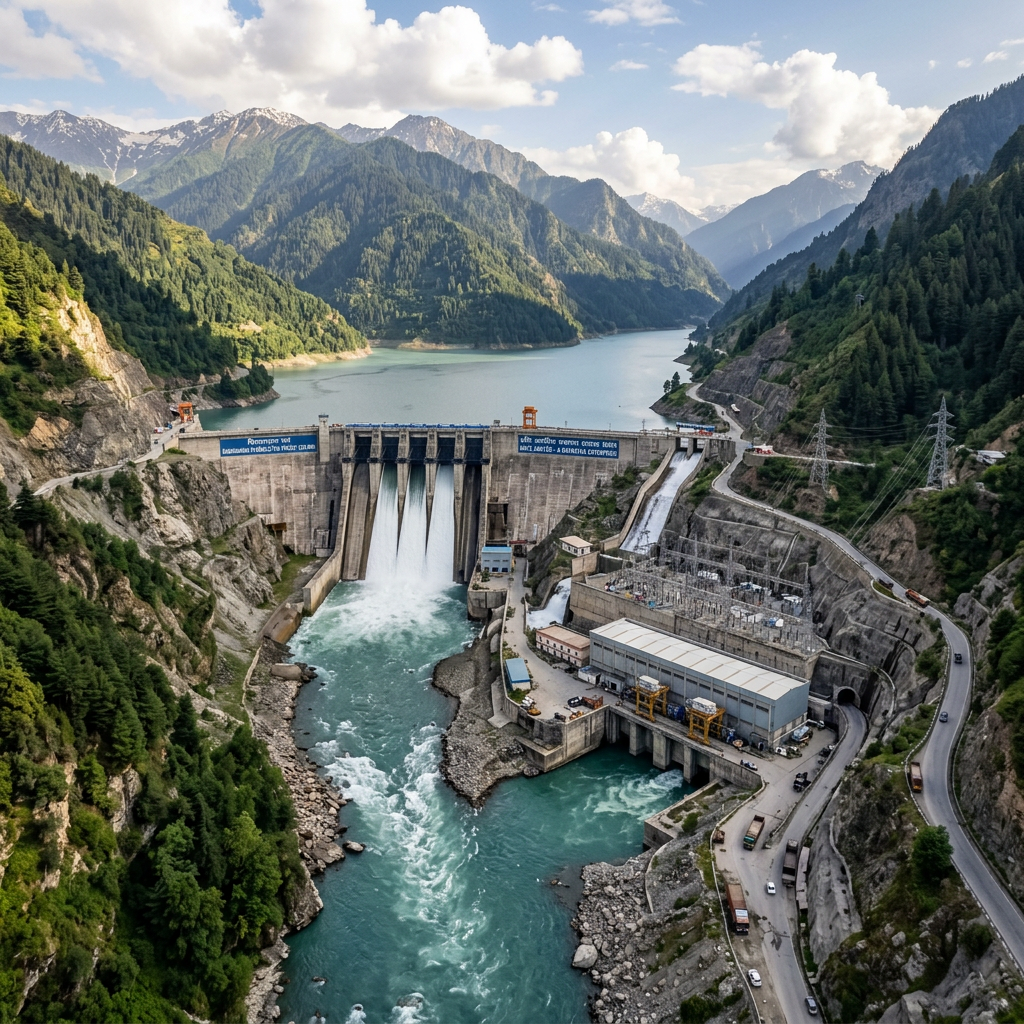
India Won at The Hague in 2013.
The Court It Won At Is the Same Court
It Now Calls Illegal.
On May 15, 2026, India’s MEA called the Court of Arbitration on the Indus Waters Treaty “illegally constituted.” The problem: India built a 330 MW dam on the basis of that court’s 2013 ruling. Here is what nobody is reporting.
at Kishanganga via the same court
and accepted a ruling from this court
free of treaty constraints by 2031
In this article
What this analysis examines
This piece examines a specific factual contradiction in India’s stated legal position on the Indus Waters Treaty. It does not argue India is wrong to pursue its water and hydropower interests. It argues that India’s legal basis for calling the Court of Arbitration “illegally constituted” cannot survive scrutiny once you know what India did with that same court in 2013. The strategic logic of India’s position is examined separately and on its own terms.
India’s MEA rejected the Court of Arbitration’s latest ruling on May 15 and called the body “illegally constituted.” Most outlets reported what India rejected. Nobody reported this: India built a 330 megawatt hydroelectric dam in Jammu and Kashmir based on a ruling from that exact same court in 2013. Modi inaugurated it personally. It generates electricity right now.
The position India holds in 2026 is not a legal argument. It is a position of convenience. And the court itself has already said so, citing India’s own 2013 conduct as its evidence.
What Is the Court of Arbitration and How Was It Built Into the Treaty?
The 1960 Indus Waters Treaty built a three-tier dispute system directly into its text. India and Pakistan have different views on which tier the current dispute belongs to. But India’s own actions in 2013 make its current position legally untenable.
The Indus Waters Treaty, signed in Karachi on September 19, 1960 between Jawaharlal Nehru and Pakistan’s President Ayub Khan, with the World Bank as co-signatory, divided the Indus river system between the two countries. It gave Pakistan 80 percent of the water through the three western rivers: the Indus, Jhelum and Chenab. It gave India the three eastern rivers and limited rights to build run-of-river hydropower on the western rivers.
The treaty built a graduated dispute resolution mechanism into its text, with three distinct tiers designed for different levels of disagreement:
| Tier | What It Is Called | Who Handles It | What Types of Issues It Covers | India’s Current Position |
|---|---|---|---|---|
| 1 | Permanent Indus Commission (PIC) | Two commissioners, one from each country, meeting annually | Routine questions: river flows, data sharing, minor technical queries | Stopped attending in 2024 |
| 2 | Neutral Expert (NE) | A single highly qualified engineer | Technical differences: design specifications, flow calculations, engineering parameters | Participates in NE proceedings |
| 3 | Court of Arbitration (CoA) | Five-member tribunal, PCA provides secretariat at The Hague | Legal and interpretive disputes under Annexure G of the treaty | Calls it “illegally constituted” |
India’s argument is that the Kishanganga and Ratle dam design disputes are Tier 2 issues: technical differences that should go to the Neutral Expert. Pakistan’s argument is that they have crossed into Tier 3: legal interpretation of what the treaty permits. The entire legitimacy debate reduces to which tier is correct. But India’s credibility on this question was spent in 2013.
What Happened at The Hague in 2013 and Exactly What India Won
India participated in a Court of Arbitration under the exact same Annexure G provision from 2010 to 2013. India appointed its own arbitrators. India appeared and argued. India won the central question. India built the dam. Modi inaugurated it in May 2018. The court India calls illegal in 2026 is the institution that made all of this possible.
Pakistan raised its first objection to India’s Kishanganga Hydroelectric Project in 2007. The project, on the Kishanganga River in Bandipora district of Jammu and Kashmir, was designed to divert water through a 23-kilometre tunnel to an underground powerhouse generating 330 megawatts of electricity.
Pakistan took the dispute to the Court of Arbitration in May 2010. A seven-member tribunal was constituted on December 17, 2010, under Annexure G of the IWT. The panel was chaired by Judge Stephen Schwebel, a former President of the International Court of Justice. The proceedings unfolded over three years:
The inescapable fact
India used the Court of Arbitration under Annexure G to secure the legal clearance to build Kishanganga. Without the 2013 ruling, the 330 MW project does not exist. The court India calls illegal in 2026 is the court that gave India the dam it inaugurated in 2018. India cannot unknow what it won in 2013. The legal record is permanent and publicly available.
The PCA Used India’s Own 2013 Conduct to Reject India’s 2026 Position
When India raised competence objections to the current CoA, the PCA cited India’s own 2013 participation as the evidence against India’s position. In 2013, India questioned the court’s jurisdiction and still appeared and appointed arbitrators. That conduct established a precedent India cannot now reverse.
When Pakistan filed its new Request for Arbitration in August 2016 over the remaining design issues for Kishanganga and the Ratle project, India again raised competence objections. India said the disputes were technical, not legal. India said a Neutral Expert should handle them. India called the new CoA illegally constituted.
The PCA rejected every objection. But the specific legal reasoning it used is what makes India’s current position structurally impossible to sustain.
“In those proceedings, while India did not accept that the PCA was competent to resolve the dispute in 2013, it nonetheless appointed two arbitrators and appeared before the PCA. The PCA found that India had accepted that, under the terms of the Treaty, its objections regarding competence were to be decided by the PCA and were not a question that it could determine unilaterally.”
Linklaters ArbitrationLinks analysis of PCA 2023 award
India raised competence objections in 2013 and participated anyway. India appointed its own arbitrators in 2013. By doing so, India established that competence questions are for the PCA to determine, not for India to determine unilaterally. India’s own lawyers, in 2013, created the precedent that now dismantles India’s 2026 argument.
The PCA proceeded in the current case on the basis that India had already accepted this principle. India’s 2013 participation was cited as the evidentiary basis for rejecting India’s 2016 objections. India cannot un-participate in 2013. It cannot un-win what it won. The court remembered what India’s lawyers apparently hoped the world would forget.
What the May 15 Ruling on Maximum Pondage Actually Says
The Court of Arbitration’s May 15 supplemental award rules on how much water India can store at the Ratle project before releasing it downstream. India’s proposed storage volume contravenes the treaty. India calls the award void. The practical consequence is a constraint on J&K’s electricity generation during winter months when power shortage is most severe.
The current dispute centres on the Ratle Hydroelectric Project, an 850 megawatt dam under construction on the Chenab River in Kishtwar district of Jammu and Kashmir. Ratle was 21 percent complete as of May 2025. Expected commissioning is 2028. When operational, it will generate 3,136 million units of electricity annually, enough to power a medium-sized Indian city.
What is maximum pondage?
Pondage is the volume of water a run-of-river dam can store in its reservoir at any time before releasing it downstream. The IWT strictly limits pondage on India’s western river dams to prevent India from controlling the timing and volume of flows into Pakistan. A larger pondage allows a dam to store water accumulated over several days and release it through turbines in controlled bursts, maintaining power generation during lean flow seasons. India proposed a maximum pondage of 23.86 million cubic metres for Ratle. The May 15 CoA award ruled that India’s calculation method for this figure contravenes Paragraph 8(c) of Annexure D of the IWT.
If the ruling were enforced, Ratle would generate less electricity during winter and pre-monsoon months, precisely when J&K’s demand is highest and its power shortage bites hardest. The region currently imports significant power and is planning to add 3,700 megawatts of new capacity by 2031 to become energy self-sufficient. Ratle is central to that plan.
India rejected the award immediately. MEA spokesperson Randhir Jaiswal said the CoA had issued a “so-called award” and that India “categorically rejects the present so-called award, just as it has firmly rejected all prior pronouncements of the illegally constituted CoA.” India has not modified its Ratle designs and construction continues.
| Project | Capacity megawatts | River | Status | Treaty Position | India’s Stance on CoA |
|---|---|---|---|---|---|
| Kishanganga | 330 MW | Kishanganga (Jhelum tributary) | Operational since 2018 | Built on 2013 CoA ruling | Used and accepted CoA in 2013 |
| Ratle | 850 MW | Chenab | Under construction, 21% complete (2025) | Subject of current CoA dispute on pondage limits | Calls CoA illegal, building to own specifications |
| Sawalkote | 1,856 MW | Chenab | Pre-construction, proceeding freely post-suspension | Would have been contested under old treaty | IWT suspended, no constraint now |
| Dulhasti Stage II | 260 MW | Chenab | Under evaluation, proceeding post-suspension | Would have been contested under old treaty | IWT suspended, no constraint now |
| 8 planned projects | 3,704 MW total | Various western rivers | 2026-2031 pipeline | All would have faced treaty scrutiny | IWT suspended, all proceeding without review |
Source: Greater Kashmir, Rising Kashmir, Wikipedia project pages, PIB press releases.
Why India’s Short-Term Strategic Calculation Makes Sense
India is not acting irrationally. The IWT as written was producing a situation where Pakistan could trigger international dispute proceedings to delay every new Indian dam for years. India has identified a window to build its hydropower pipeline without that constraint. The short-term gain is real and significant.
The IWT as signed in 1960 gave Pakistan 80 percent of the total water from the Indus system. India received the three eastern rivers and limited, constrained rights to build run-of-river hydropower on the western rivers. In 1960, this was a reasonable post-Partition compromise. India secured the eastern rivers for its Punjab and Rajasthan irrigation needs. Pakistan secured the western rivers for its agricultural heartland.
Sixty-five years later, the equations have changed. J&K has an identified hydroelectric potential of over 20,000 megawatts on the rivers allocated to Pakistan. The region has a chronic power deficit. India is one of the most water-stressed large countries in the world. And the treaty’s dispute resolution mechanism had, from India’s perspective, become a tool Pakistan used to freeze every project in legal limbo.
- Kishanganga faced 11 years of delay from Pakistan’s 2007 objection to the 2013 CoA ruling to the 2018 commissioning.
- Ratle has faced objections since 2013 and is still only 21 percent complete in 2025, despite starting construction in 2019.
- Sawalkote at 1,856 MW would have been subject to the same mechanism. Under the suspended treaty it proceeds without restriction.
- Eight planned projects totalling 3,704 MW between 2026 and 2031 would each have faced Pakistan’s ability to trigger proceedings. Under the suspended treaty, none do.
By suspending the treaty and rejecting the CoA, India has cleared the legal path for approximately 8,000 megawatts of new hydropower in J&K without the years-long delay that treaty dispute mechanisms would have imposed on each project. That is a real and significant gain for a region that imports power and needs it urgently.
The strategic logic is coherent. The legal argument India uses to justify it is not.
The Long Game India Is Losing: China and the Brahmaputra
The Brahmaputra carries more water into India than all six Indus rivers combined. China is upstream. China is building the world’s largest dam at the Great Bend. India has no treaty with China on the Brahmaputra and has relied entirely on international water law norms as a constraint on upstream nations. India just demonstrated those norms can be rejected unilaterally. China noticed.
The Brahmaputra River originates in Tibet as the Yarlung Tsangpo, drops through one of the world’s deepest gorges at what China calls the Great Bend, and enters Arunachal Pradesh before flowing through Assam and into Bangladesh. The river carries approximately 165 billion cubic metres of water into India annually: more than the combined annual flow of all six Indus rivers.
China is building the Great Bend hydropower project on the Yarlung Tsangpo before it crosses into India. Estimated generating capacity: 60,000 megawatts. Roughly three times India’s entire existing hydropower capacity. The project will give China the technical ability to control the timing and volume of water flows into India’s northeast, with consequent effects on Assam’s agriculture, Arunachal Pradesh’s rivers and Bangladesh’s delta downstream.
India has no bilateral water treaty with China on the Brahmaputra. China has consistently refused to negotiate one. India’s only recourse has been to invoke international water law norms: the principles codified in the 2014 UN Watercourses Convention requiring equitable and reasonable utilisation, and prohibition on causing significant harm to downstream users.
On May 15, 2026, India’s MEA formally stated that an upstream nation can:
- Suspend a water treaty unilaterally and declare the suspension “fully valid” despite no treaty provision permitting it.
- Call an international arbitration tribunal “illegally constituted” and refuse to participate in its proceedings.
- Declare the tribunal’s awards “null and void” and proceed with dam construction regardless of its rulings.
- Build new hydropower infrastructure on rivers allocated to a downstream country without submitting to agreed dispute mechanisms.
Every one of these positions is precisely what India needs China not to be able to do on the Brahmaputra. India has now established, in official MEA statements, the legal and diplomatic framework that an upstream nation can apply to a downstream neighbour. China’s water diplomacy lawyers have read those statements.
When India’s representatives raise the Brahmaputra in bilateral talks with China, or in multilateral forums, China’s response is now written in India’s own foreign ministry press releases. The argument India needs to make against China’s Great Bend project is the argument India rejected when it was applied to India on the Indus.
What Happens Next at The Hague
The court will proceed regardless. India’s non-participation does not end the proceedings. The tribunal can draw adverse inferences, proceed ex parte, and issue a final award. India will reject that too. But the legal record accumulates across every forum India participates in.
Annexure G of the IWT is unambiguous on this point: once arbitration is validly triggered and the tribunal has confirmed jurisdiction, proceedings continue whether or not both parties appear. The court confirmed jurisdiction in its 2023 Award on Competence. India’s suspension of the treaty does not affect the tribunal’s authority: the CoA has explicitly ruled that India’s unilateral declarations have no legal effect on the treaty’s continued force.
The court can proceed ex parte, meaning on the basis of Pakistan’s evidence and arguments alone. In international arbitration, when a party refuses to submit evidence that has been specifically ordered, the tribunal can draw adverse inferences: it can assume that the withheld evidence would have been unfavourable to the non-complying party. India was ordered to submit operational logbooks from Baglihar and Kishanganga. India declined. The tribunal noted the refusal.
A final award will be issued. It will direct India to modify Ratle’s design to comply with treaty pondage limits. It will cite adverse inferences from India’s data refusal. India will call it void. But the award will enter the permanent record of international treaty law, cited in academic literature, referenced in other treaty disputes, and available to Pakistan’s legal teams in every forum where India appears as a state that claims to uphold rules-based international order.
The enforcement gap is real but not absolute
International arbitration tribunals cannot compel compliance the way domestic courts can. There is no enforcement mechanism that can force India to modify Ratle’s dam design. But enforcement is not the only consequence. Pakistan can present the CoA’s final award in international financial institutions when Indian projects seek multilateral financing. It can raise India’s treaty violations at the UN. It can use the award to build a sustained international narrative about India as a state that accepts international law only when outcomes favour it.
The One Question India Has Not Answered
India has never explained, in any official statement, why the Court of Arbitration constituted under Annexure G in 2010 was legitimate enough for India to participate in, win at, and build a nationally celebrated dam upon, while the Court of Arbitration constituted under the same Annexure G in 2016 is “illegally constituted.” There is no answer that does not expose the contradiction.
Every official MEA statement on the current CoA calls it “illegally constituted.” No statement explains, with reference to the treaty text, why the 2016 constitution was illegal while the 2010 constitution was not. Both were constituted under Annexure G. Both were triggered by a Pakistan Request for Arbitration. Both convened at the Peace Palace in The Hague with the PCA as secretariat. The institutional mechanism is identical.
India’s distinction rests on one argument: that the current dispute is technical, belonging at Tier 2 with the Neutral Expert, rather than legal, belonging at Tier 3 with the CoA. But India made the same argument in 2013 and still participated. And the PCA has already ruled, citing India’s own 2013 conduct, that this is a question for the tribunal to decide, not for India to decide unilaterally.
The 2013 case was also initiated by Pakistan under Annexure G. India also questioned jurisdiction in 2013. India also participated. India also received an award. India accepted the award when it went India’s way.
The MEA’s language has grown more aggressive since 2023: from “illegally constituted” to proceedings that are “null and void” to calling the May 15 award a “charade at Pakistan’s behest.” None of this language addresses the factual record of 2013. None of it explains why the same institution, constituted under the same provision, is legitimate in 2013 and illegal in 2026.
India used the court when the court served India’s interests. India is rejecting the court because the court is no longer serving India’s interests. That is a defensible political calculation. It is not a legal argument. And it is precisely the precedent China is watching India establish on a river that matters far more to India’s future than the Kishanganga ever will.
Frequently Asked Questions
Sources
- PCA: Indus Waters Kishanganga Arbitration (Pakistan v. India), Final Award, December 20, 2013 : jusmundi.com
- ASIL Insights: The Indus Waters Kishenganga Arbitration (Pakistan v. India) : asil.org
- Linklaters ArbitrationLinks: PCA considers its competence under the IWT : linklaters.com
- BusinessToday: No jurisdiction, no authority: India rejects tribunal order, February 2, 2026 : businesstoday.in
- Daily Pioneer: India rejects Indus Waters Treaty court award, May 15, 2026 : dailypioneer.com
- Express Tribune: Indus Waters Treaty at the crossroads: Arbitration, obligations, and the rule of international law, February 8, 2026 : tribune.com.pk
- Wikipedia: Kishanganga Hydroelectric Project : wikipedia.org
- Wikipedia: Ratle Hydroelectric Plant : wikipedia.org
- World Bank: Fact Sheet: The Indus Waters Treaty 1960 and the Role of the World Bank : worldbank.org
- NPR: With Indus Waters Treaty in the balance, Pakistan braces for more water woes, July 2025 : npr.org
- CSIS: Can India Cut Off Pakistan’s Indus River Lifeline? : csis.org
- Rising Kashmir: J&K set to double hydropower capacity by 2030 : risingkashmir.com
- Greater Kashmir: J&K’s 15 power projects of 7,768 MW at different stages of execution : greaterkashmir.com
- PIB: Prime Minister inaugurates Kishanganga Hydroelectric Project, May 2018 : pib.gov.in
- Chatham House: India and Pakistan still cannot agree to restore the Indus Waters Treaty, April 2026 : chathamhouse.org
Dilshad is a journalist, filmmaker and digital marketing expert covering Indian foreign policy, national security and political economy at TNT News.
Leave a Reply