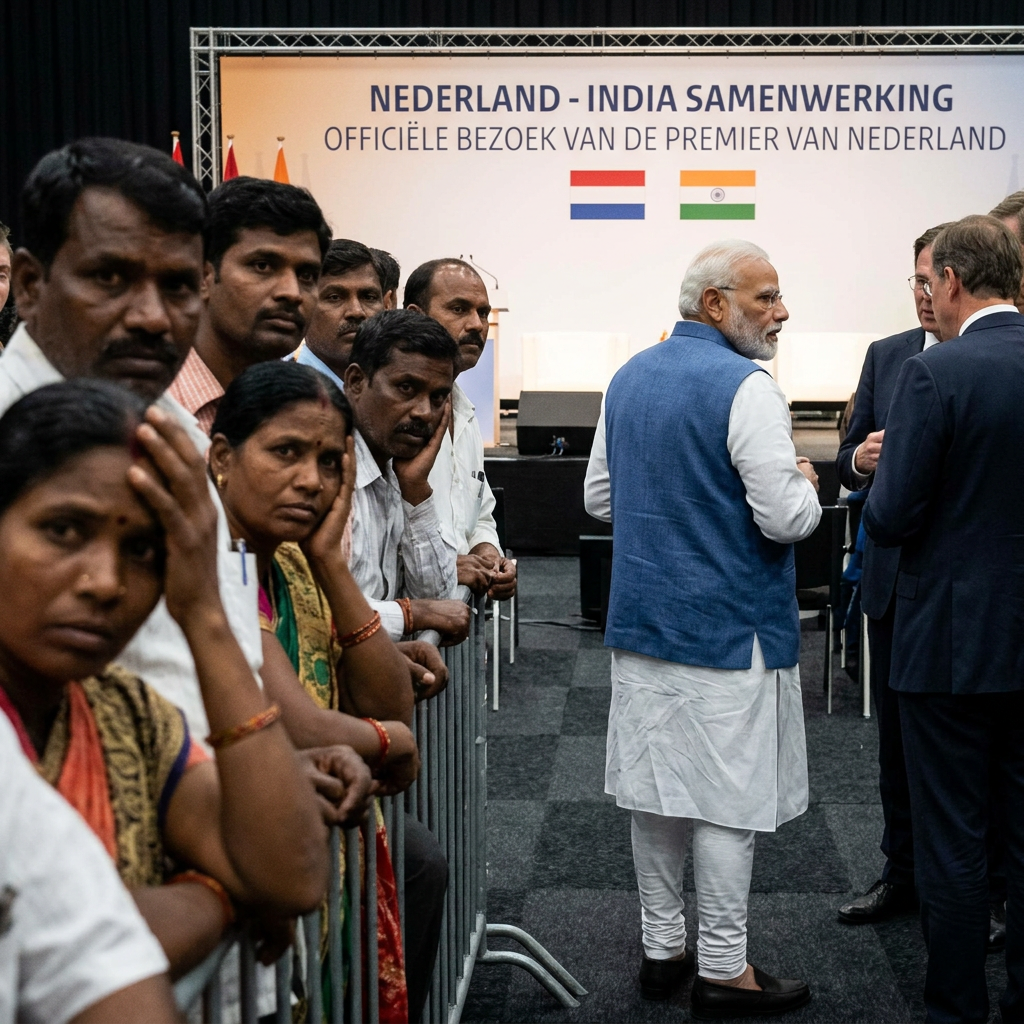
Modi decade of disasters warning from The Hague on May 16, 2026 named three compounding global crises. This investigation examines the Modi decade of disasters framing, what the three crises mean for India right now, and what Dutch PM Jetten added to the conversation that Indian media did not report.
Modi Warned the World of Three Crises From The Hague.
His Dutch Host Reminded It of a Fourth.
COVID. Wars. Energy crisis. Modi’s “decade of disasters” had three chapters at The Hague. The Dutch Prime Minister publicly added one India did not mention. Indian media did not report it.
The four crises at The Hague on May 16, 2026
- On May 16, 2026, Modi warned from The Hague that “this decade is turning into a decade of disasters” and that decades of development achievements could be reversed.
- Modi named three crises: COVID pandemic, wars, and the global energy crisis. He warned all three threatened to push millions back into poverty.
- Before the meeting, Dutch PM Jetten told reporters there were growing EU concerns about press freedom and minority rights in India. “The concern is to what extent India remains an inclusive society.”
- Insiya Hemani, a 12-year-old Dutch girl, was violently abducted from Amsterdam in 2016 by her father and smuggled to India. Dutch courts convicted him to 8.5 years. India’s courts gave him custody. Her mother has not seen her in ten years.
- India is not signed to the 1980 Hague Convention on child abduction, making it a legal safe haven for international child abductors. The Modi government formally decided not to ratify it in 2016.
- When a Dutch journalist asked the MEA about Jetten’s remarks on minority rights, the official said: “I would not like to comment on this at this stage.”
- Indian media reported the partnership outcomes. The fourth crisis, the Insiya protests and Jetten’s press remarks were not covered in most Indian outlets.
In this article
On May 16, 2026, Narendra Modi stood in The Hague and warned the world that decades of development could be wiped out. He named three crises. His host had already named a fourth. India reported the warning. It did not report the response.
Modi’s Five-Nation Tour and What the Netherlands Visit Actually Delivered
The Netherlands was the second of five stops: UAE, Netherlands, Sweden, Norway, Italy. The visit produced 17 bilateral outcomes including the ASML-Tata MoU and the confirmed India-EU Free Trade Agreement. These were reported. What else happened at The Hague was not.
| Country | Dates | Primary Objective |
|---|---|---|
| UAE | May 15 | Energy security: UAE to store 30 million barrels in India’s strategic petroleum reserve |
| Netherlands | May 15-17 | ASML semiconductors, green hydrogen, EU-FTA, India-Netherlands Strategic Partnership |
| Sweden | May 17-18 | European Round Table for Industry with Ursula von der Leyen, AI and supply chains |
| Norway | May 19 | 3rd India-Nordic Summit: green hydrogen and Arctic cooperation |
| Italy | May 19-20 | Defence co-production and EU-FTA implementation with PM Meloni |
The Netherlands visit produced 17 substantive bilateral outcomes. The headline: ASML and Tata Electronics signed an MoU committing to semiconductor chip manufacturing in India using ASML equipment. ASML makes the extreme ultraviolet lithography machines essential for advanced chip production, the same machines denied to China under US export controls. India getting ASML access establishes a supply chain position no other developing country currently holds.
Modi confirmed the India-EU Free Trade Agreement during the visit, describing it as “the historic India-EU Free Trade Agreement signed this year.” The Netherlands is one of India’s largest European trade partners at USD 27.8 billion in bilateral trade. Further outcomes included a Green Hydrogen Roadmap, Critical Minerals Cooperation, Dutch Water Management partnership for Gujarat’s Kalpasar Project, a Nalanda-Groningen university partnership and the restitution of Chola-era copper plates.
These outcomes are real, significant and were reported in Indian media. The bilateral partnership story was covered thoroughly. What was also present at The Hague on May 16, in the same building, in the same day’s diplomatic record, was not.
Crisis One, Two and Three: What Modi’s Warning Actually Means for India
Modi’s three crises are not abstract. Every one of them is landing on ordinary Indians right now, simultaneously. The “decade of disasters” warning is already visible at the petrol pump, the kirana and the sabzi mandi.
“Today, humanity faces many major challenges. First came the Corona pandemic; then wars began to break out, and now there is an energy crisis. This decade is turning into a decade of disasters for the world. Unless these challenges are addressed quickly, decades of global development achievements could be reversed, pushing millions back into poverty.”
Prime Minister Narendra Modi, addressing the Indian diaspora in The Hague, May 16, 2026For India, the three crises are visible in specific numbers. The rupee is at 96 to the dollar, a record low. The government raised petrol and diesel prices by Rs 3 per litre on May 15, the first hike in four years, timed to land after election results in five states. Gold import duty has been doubled to 15 percent. IMD has forecast the 2026 monsoon at 92 percent of the long-period average, below normal, with El Nino developing in the Pacific. The Hormuz blockade has pushed Brent crude above $107 per barrel and doubled urea prices.
Modi’s warning about development being reversed was not rhetorical. For the first time since the early 1990s, India faces a genuine multi-front economic squeeze. He was right to name it from The Hague. What he did not name was the fourth pressure his host had already added to the conversation, before Modi had even entered the building.
The Fourth Crisis: What Jetten Said That India Did Not Report
Before the meeting, Dutch PM Jetten publicly told reporters there were growing EU concerns about press freedom and minority rights in India. This was not a fringe remark by a minor official. It was the head of government of a NATO member, on the day of a state visit, speaking to national press. India’s MEA declined to respond.
Before Modi arrived at the Huis ten Bosch royal palace on May 16, Jetten spoke to reporters. His remarks were published by two major Dutch newspapers, de Volkskrant and NRC.
“It is not only about press freedom, but also about the rights of minorities, who are under severe pressure. That applies in the first place to the Muslim community, but also to many other smaller communities. The concern is to what extent India remains an inclusive society where the same rights apply to everyone.”
Dutch Prime Minister Rob Jetten, to reporters before meeting Modi, May 16, 2026Jetten added that the EU-India free trade agreement under negotiation would offer opportunities to discuss these concerns alongside commercial ones. He was not making an offhand comment. He was describing EU policy, on the record, ahead of a bilateral meeting with a head of government. In diplomatic terms, this is a significant public statement.
After the dinner meeting, the MEA held a media briefing. A Dutch journalist asked specifically about Jetten’s earlier remarks on press freedom and minority rights. The MEA official confirmed only that the Insiya Hemani case “was raised by the Netherlands leadership.” On Jetten’s broader remarks, he said: “I would not like to comment on this at this stage.”
The official post-meeting X post from Jetten mentioned the Strait of Hormuz, energy prices and the Insiya case. It did not mention press freedom or minority rights. Both sides had reasons to keep the fourth crisis out of the official record.
Who Is Insiya Hemani: The Case Jetten Carried Into the Room
Insiya Hemani is 12 years old. She was violently taken from Amsterdam when she was two. Her father has been convicted by the Dutch Supreme Court. India’s courts gave him custody. Her mother has not seen her in ten years. This case has been raised at every level of India-Netherlands diplomacy since 2016, without result.
Why India Cannot Be Forced to Act: The Hague Convention Gap
India is one of the few major countries not signed to the 1980 Hague Convention on child abduction. The Modi government formally decided not to ratify it in 2016. This makes India a legal safe haven for international child abductors, and makes the Insiya case legally impossible to resolve through normal international channels.
The 1980 Hague Convention on the Civil Aspects of International Child Abduction now has 103 signatories. When a child is abducted to a Hague Convention country, the convention provides a structured mechanism for prompt return. When a child is abducted to India, no such mechanism exists. Dutch court orders are not automatically enforceable. Indian courts conduct their own independent custody review and are not bound by foreign verdicts.
India’s stated reason for not signing
India’s Law Commission recommended signing the Hague Convention in 2009. The Modi government formally decided not to ratify in 2016. The stated reason: to protect Indian women in mixed-nationality marriages abroad who flee abusive husbands and return to India with their children. Under the convention, those women could face legal pressure to return children to countries they fled for safety. This argument has genuine merit in many cases. The Insiya case is not one of them: the father abducted a child from Europe to India in a violent operation. India’s courts then gave that convicted kidnapper custody.
India’s non-signatory status has one further consequence that the government has not publicly addressed: it signals to every international parent in a mixed-nationality marriage that India will not cooperate with foreign custody orders. Legal experts have noted that this makes India a jurisdiction where child abduction to India is effectively irreversible, regardless of what foreign courts decide.
What India Reported Versus What Happened at The Hague
Indian media covered the bilateral partnership. It did not cover the fourth crisis. Here is the gap between what was reported and what actually happened at the Huis ten Bosch palace on May 16.
What Indian media covered
- India-Netherlands Strategic Partnership Roadmap signed
- ASML semiconductor cooperation agreement
- EU-India FTA discussions advancing
- Global Biofuel Alliance Netherlands joining
- Modi’s diaspora speech and “decade of disasters” warning
- Water management cooperation visit to Afsluitdijk
Why the Fourth Crisis Matters for India’s Own Development Story
Modi’s three crises are external. The fourth is internal. And it directly affects whether India can navigate the other three, because India’s EU-FTA ambitions, ASML access and European investment flows all depend on European confidence in India as a reliable, rule-based partner.
The EU-India Free Trade Agreement is the most significant trade deal India is currently negotiating. The Netherlands, as a major EU member and a gateway for Indian businesses into Europe, is a critical partner. Jetten told reporters explicitly that the FTA would offer opportunities to discuss human rights concerns alongside commercial ones.
The EU has consistently linked market access to rule-of-law and democratic standards in its trade agreements. This is not a threat. It is how EU trade policy works, and India’s government knows it. The ASML semiconductor cooperation Modi came to secure depends on the Netherlands remaining confident that India is the kind of partner that upholds international agreements and legal standards.
Modi warned that development achievements could be reversed by the crisis cascade. His Dutch host reminded the world that governance failures are also how development gets reversed. Both conversations happened in The Hague. India reported one of them.
The three crises Modi named arrive from outside India’s control: a pandemic, wars elsewhere, energy disruptions from a conflict India did not start. The fourth crisis Jetten pointed to is determined entirely by India’s own choices: which treaties it signs, how its courts handle international legal obligations, how it treats its minorities, how free its press is.
A country navigating three external crises simultaneously cannot afford its governance reputation to be the fourth. That is the argument Jetten was making. It did not appear in the official readout. It did not appear in most Indian coverage. But it was said, publicly, at The Hague, on May 16, 2026.
Frequently Asked Questions
Sources
- BusinessToday: PM Modi in Netherlands calls current era a decade of disasters, May 16, 2026 : businesstoday.in
- The Wire: Modi’s Netherlands Visit Coloured By Dutch PM’s Remarks on Rights in India, Insiya Hemani Case, May 17, 2026 : thewire.in
- NL Times: Indian PM Modi will be pressed on abducted Amsterdam girl Insiya Hemani, May 13, 2026 : nltimes.nl
- NL Times: Mother of Dutch girl abducted to India holds peaceful protest during Modi’s visit, May 17, 2026 : nltimes.nl
- NL Times: Dutch MEPs reach out to parliament in India to get kidnapped Amsterdam girl back, May 14, 2026 : nltimes.nl
- Government.nl: Joint Statement by India and the Netherlands, May 16, 2026 : government.nl
- Library of Congress: India: Decision Not to Sign Hague Treaty on Child Abduction, 2017 : loc.gov
- LiveLaw: Is It Time for India to Reconsider Its Stand on the Hague Abduction Convention? : livelaw.in
- Open Magazine: From Energy Crisis to AI Growth: Key Takeaways from PM Modi’s Speech in Netherlands, May 16, 2026 : openthemagazine.com
- US State Department: India International Parental Child Abduction Information : travel.state.gov
Dilshad is a journalist, filmmaker and digital marketing expert covering Indian politics and elections at TNT News.
Leave a Reply