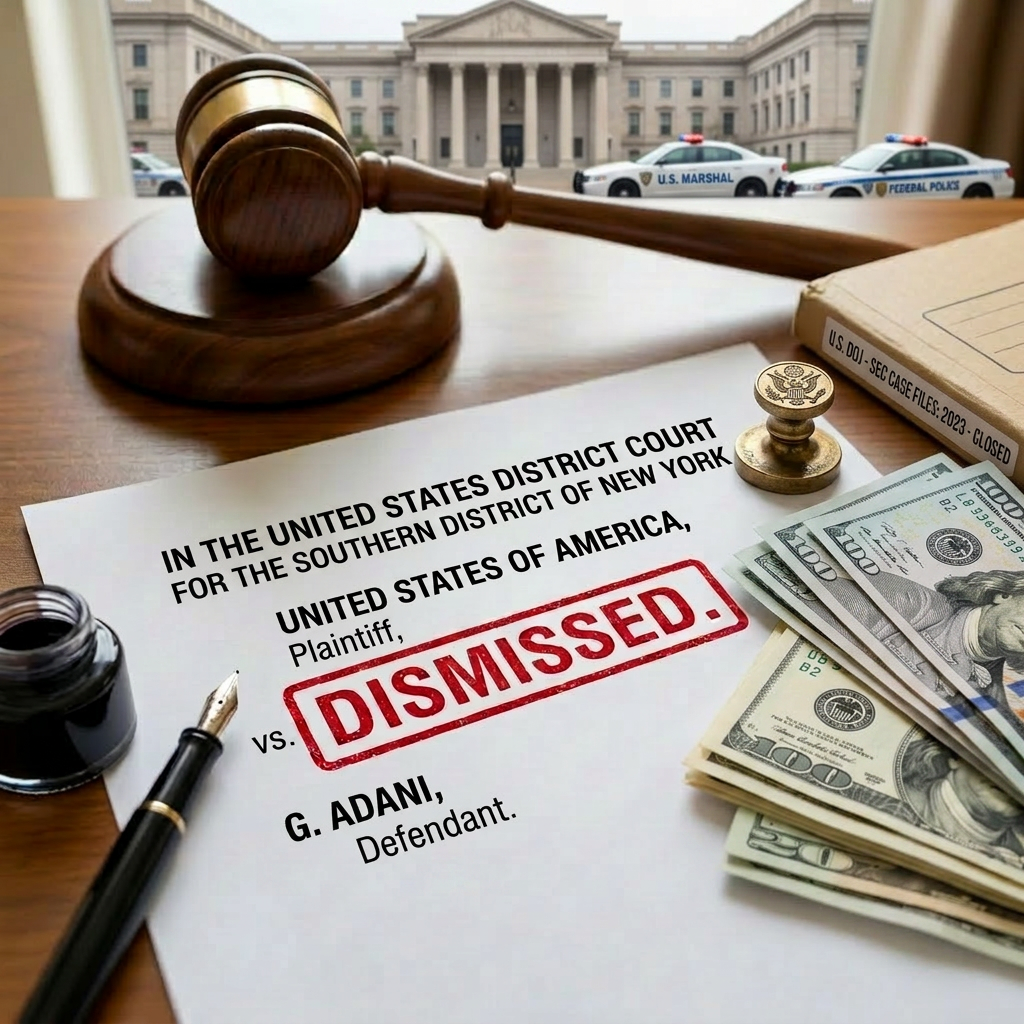
The DOJ drops Adani charges 2026 story is not a legal story. It is a political economy story
The Third Transaction: Adani’s Team Walked Into DOJ Headquarters With 100 Slides and a $10 Billion Promise. They Walked Out With a Permanent Dismissal.
All criminal charges against Gautam Adani dropped with prejudice. Three US investigations closed in four days. Adani’s lawyer is Trump’s personal attorney. The DOJ called it prosecutorial discretion. The New York Times reported what was on the other slide.
- DOJ dropped all criminal charges against Gautam Adani and Sagar Adani with prejudice on May 18, 2026. Permanent. Cannot be refiled.
- Three US investigations closed in four days: DOJ criminal (dropped), SEC civil ($18M settlement, no admission), Treasury OFAC ($275M for Iran sanctions).
- Adani’s lead counsel is Robert J. Giuffra Jr., one of Donald Trump’s personal lawyers.
- In April 2026, Giuffra presented 100 slides at DOJ headquarters. One slide offered $10 billion in US investment and 15,000 jobs if charges were dropped.
- The original charges (November 2024, Biden DOJ) alleged a $265 million bribery scheme paying Indian officials for solar energy contracts. Adani Group denied all allegations throughout.
- Adani Group stocks surged. Adani Enterprises +3.5%. Adani Ports hit a record high. Gautam Adani’s estimated net worth rebounded to approximately $109 billion.
- The DOJ’s letter to Judge Nicholas Garaufis was nine lines long. It cited prosecutorial discretion. It made no reference to the investment pledge.
The Three Transactions
Before the details of the Adani case, a pattern TNT News has documented this week.
This is the context in which the DOJ’s phrase “prosecutorial discretion” must be read.
What Was Actually Dropped
The DOJ drops Adani charges 2026 decision reverses an indictment filed by Brooklyn US Attorney Breon Peace under the Biden administration in November 2024, accused Gautam Adani and Sagar Adani of securities fraud and wire fraud. Prosecutors alleged they concealed a $265 million bribery scheme from American investors and global lenders while raising capital in international markets. The alleged bribes were paid to Indian government officials to secure solar energy supply agreements for Adani Green Energy, generating approximately $2 billion in profits over 20 years.
The Adani Group denied all allegations throughout. Adani Green Energy’s $600 million foreign bond offering, three times oversubscribed, was cancelled the day after the indictment.
Important legal detail most outlets have not highlighted: Gautam Adani, Sagar Adani and Vneet Jaain were charged only under securities and wire fraud statutes. They were NOT named in the more serious Foreign Corrupt Practices Act bribery charges or obstruction counts brought against other individuals in the broader indictment. The personal direct link from Adani to the bribery allegation was always the weakest element of the prosecution’s case.
The Three Simultaneous Settlements
The combined civil and regulatory payments total $293 million. The original allegations centred on a $265 million bribery scheme. Adani paid more in settlements than the alleged bribes totalled, while denying the bribes occurred and receiving no criminal conviction.
The Legal Team and the 100-Slide Presentation
The Adani Group’s change of legal strategy in early 2026 was not subtle. Robert J. Giuffra Jr. of Sullivan and Cromwell was appointed lead counsel. Giuffra is one of Donald Trump’s personal lawyers. The choice of counsel was a statement about the intended channel of resolution before a single slide had been written.
Four additional firms joined the effort: Nixon Peabody, Hecker Fink, Norton Rose Fulbright and Bracewell. Five law firms. One client. One presentation.
In April 2026, Giuffra led a delegation to DOJ headquarters in Washington. The presentation ran to approximately 100 slides and made two primary legal arguments.
The jurisdiction argument: All alleged conduct occurred in India. The defendants are Indian nationals. The issuer is an Indian company. The securities were not listed on US exchanges. The defence called this an “impermissibly extraterritorial application” of US securities laws. American courts, the argument went, cannot reach Indian conduct involving Indian securities simply because some US investors purchased bonds in international markets.
The evidence argument: Prosecutors could not establish a direct evidentiary link between Gautam Adani personally and the $265 million bribery scheme. This was the gap the defence had identified from the beginning. The FCPA charges did not name him. The securities fraud charges required a chain of knowledge that the defence challenged at every link.
And then the other slide.
Per the New York Times and Bloomberg: One slide offered the government a sweetener. If prosecutors dropped the charges, Adani would invest $10 billion in the American economy and create 15,000 jobs. Adani said he wanted to invest in the United States but “could not do so while the cases proceeded.” The investment was explicitly conditional on the outcome.
Why the DOJ Drops Adani Charges 2026 Decision Was Not a Surprise: The Timeline of Signals
The Market Impact
| Company | Price (Rs) | Change | Note |
|---|---|---|---|
| Adani Enterprises (ADEL) | 2,803.10 | +3.5% | Strong gap-up open |
| Adani Ports (ADANIPORTS) | 1,823.90 | +2.5% | 52-week record high |
| Adani Power | 229.00 | +3.2% | High volumes |
| Adani Green Energy | 1,457.00 | +3.0% | Best level since late 2024 |
The November 2024 indictment had cost Adani Group companies tens of billions in combined market capitalisation and forced the cancellation of a three-times-oversubscribed $600 million bond offering. The May 2026 reversal is a direct restoration of that value. Gautam Adani’s estimated net worth has rebounded to approximately $109 billion, reinforcing his position as Asia’s wealthiest individual.
The Indian Political Dimension
When the DOJ filed the indictment in November 2024, the Indian opposition built an entire political narrative around it. Rahul Gandhi demanded Adani’s arrest. Congress issued multiple statements connecting the US charges to what they described as the Modi government’s protection of a favoured billionaire. The international criminal indictment was their most credible piece of evidence.
That evidence is now gone.
The dismissal does not establish that the allegations were false. It establishes that the Trump DOJ chose not to devote further resources to the case after a presentation that included a $10 billion investment pledge. The distinction matters enormously. The Adani Group did not secure a not-guilty verdict. It secured a with-prejudice dismissal through a presentation made by the US president’s personal lawyer.
The opposition faces a genuine strategic problem. To attack the outcome, they must attack the Trump DOJ’s decision, which requires criticising a US administration they have elsewhere been happy to invoke. To accept the outcome is to accept the framing that the charges lacked merit. Watch Parliament on Tuesday. The silence will be as informative as the speech.
The BJP and the Modi government will treat this as unambiguous vindication. Adani Group’s statement will say the outcome confirms what they always maintained: the allegations were baseless. Both of those responses are politically predictable. Neither of them addresses what was on slide 100 of the April presentation.
The Number Nobody Is Mentioning
The Adani Group’s combined payments: $18 million to the SEC, $275 million to the Treasury OFAC. Total: $293 million.
The original allegations: a $265 million bribery scheme.
The Adani Group paid more in civil settlements than the alleged bribes totalled, while denying the bribes occurred, receiving no criminal conviction and no admission of wrongdoing.
This is not a contradiction the DOJ must resolve. The SEC and OFAC matters are separate from the criminal case. The payments relate to different alleged violations under different statutes. But it is an accounting that deserves to be stated plainly before anyone uses the phrase “completely vindicated.”
The DOJ’s letter to Judge Garaufis is nine lines long. It cites prosecutorial discretion. It does not mention the 100-slide presentation. It does not mention the $10 billion investment pledge. It does not mention Robert Giuffra.
Prosecutorial discretion is a real and legitimate legal concept. Cases are dropped because evidence is insufficient, because jurisdiction is unclear, because priorities change. The jurisdiction argument is legally serious. The evidence gap on Adani’s personal involvement may be real. Breon Peace’s departure removed the case’s institutional champion.
But one slide in a 100-slide presentation offered the government a $10 billion economic benefit if it dropped the charges. The government dropped the charges. The sequence is public. The documents exist.
The DOJ called it prosecutorial discretion. The New York Times reported what was on the other slide. You now have both descriptions. Draw your own conclusion about which one is more complete.
Frequently Asked Questions
Sources
- 01
- 02
- 03
- 04
- 05
- 06
- 07
- 08
- 09
Dilshad is a journalist, filmmaker and digital marketing expert covering Indian foreign policy, national security and political economy at TNT News.
Leave a Reply