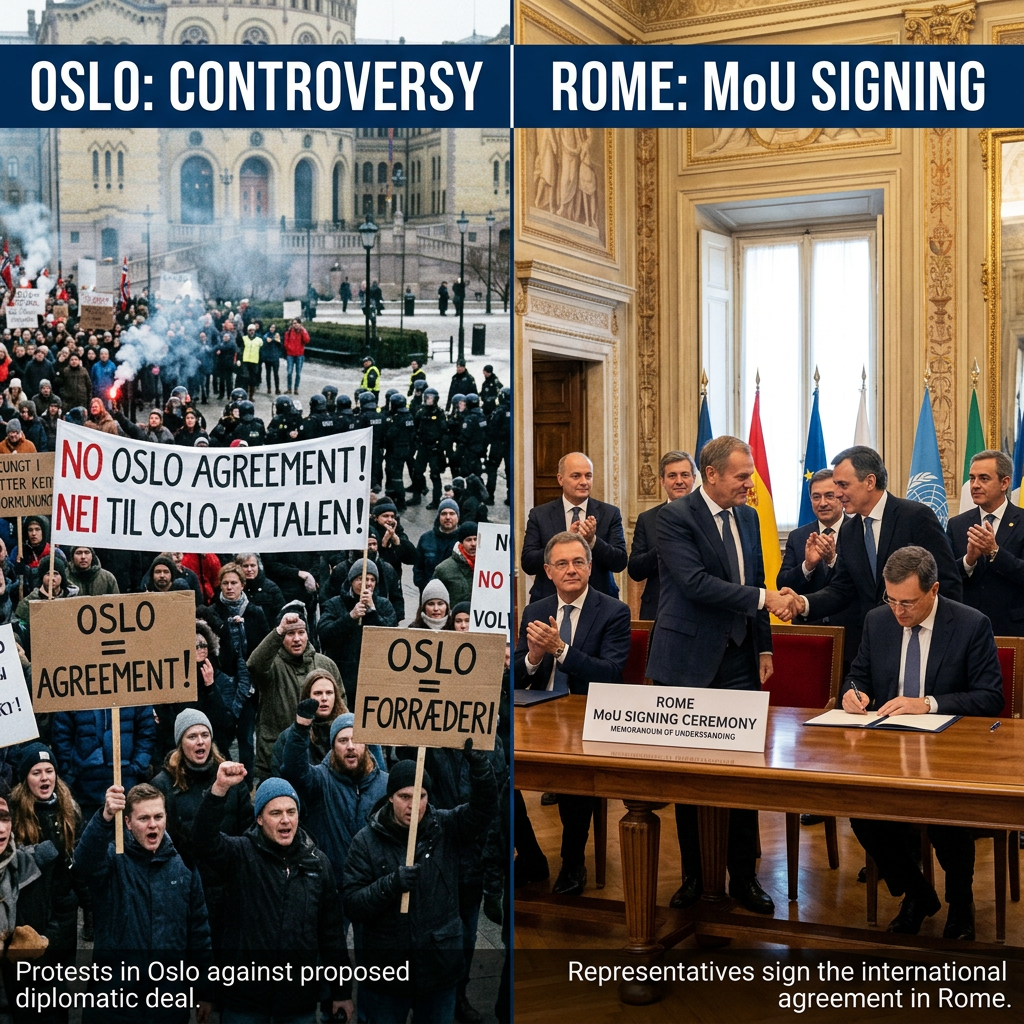
Oslo Gave India a Cartoon. Rome Gave India a Deal. Both Happened in 48 Hours. | Modi Norway Visit 2026
India’s Europe tour 2026 produced an Aftenposten cartoon that dominated Twitter and a Green Strategic Partnership that did not. Modi is now in Rome with Giorgia Meloni while Europe’s attention turns to Gaza.
The Modi Norway visit 2026 generated two simultaneous stories that most Indian coverage treated as unrelated. Aftenposten’s snake charmer cartoon filled social media from Oslo to Mumbai within hours of publication on May 19. The India-Norway Green Strategic Partnership, signed in the same city on the same trip, covering critical minerals, AI and defence, was buried beneath the outrage. By the time Twitter finished arguing about the cartoon, Modi had already flown to Rome.
Quick Answer: Modi Norway Visit 2026
- Modi visited Norway on May 19-20, 2026, for the India-Nordic Summit, meeting PM Jonas Gahr Støre.
- Aftenposten published a cartoon by Frank Rossavik depicting Modi as a snake charmer with a fuel-station pipe as the snake, hours before he landed in Oslo.
- India and Norway upgraded ties to a Green Strategic Partnership covering critical minerals, AI and defence.
- Norwegian journalist Helle Lyng publicly questioned why Modi took no press questions. Indian diplomat Sibi George responded on India’s behalf.
- Modi flew from Oslo to Rome on May 20 and met Giorgia Meloni, signing MoUs under the Joint Strategic Action Plan 2025-2029.
- India-Italy bilateral trade stood at $16.77 billion in 2025. Meloni is simultaneously handling Israel’s seizure of flotilla activists including Italian citizens.
- The cartoon was the story India covered. The partnerships signed in both cities will matter longer.
What happened during Modi’s Norway visit in 2026?
Modi arrived in Oslo on May 19, 2026, for the India-Nordic Summit, meeting Norwegian Prime Minister Jonas Gahr Støre in bilateral talks that covered energy cooperation, critical minerals, AI development and defence, culminating in an upgrade of bilateral ties to a Green Strategic Partnership, the most significant diplomatic elevation in India-Norway relations in years.
The visit produced immediate friction on two fronts. Norwegian journalist Helle Lyng publicly questioned why Modi did not take questions from the media during his joint press appearance with PM Støre. Indian diplomat Sibi George responded on behalf of the Ministry of External Affairs, stating that anyone with grievances could approach the courts. Hours before Modi landed, Aftenposten, Norway’s largest broadsheet, published Frank Rossavik’s cartoon depicting the Prime Minister as a snake charmer holding a fuel-station pipe as the snake, alongside a piece titled “A Clever and Slightly Annoying Man.”
Was the Aftenposten Modi cartoon racist or a press freedom comment?
Both. The honest answer is both, and that is why it stings.
The Aftenposten cartoon is both a lazy colonial stereotype and a pointed political comment, and treating it as only one of those things is the analytical error most Indian commentary made on May 19, choosing outrage over the more uncomfortable question of what the cartoon was actually trying to say.
The snake charmer image is rooted in colonial-era caricature. A Spanish newspaper used the same imagery in 2022 when covering India’s economic rise, drawing similar condemnation. In 2014, Modi spoke at Madison Square Garden about India transforming from a country dismissed as a land of snake charmers into a nation of mouse charmers driven by technology. Aftenposten’s cartoon proved that particular journey is not yet complete in the European editorial imagination. It was lazy. It was colonial. It belongs to a tradition of visual shorthand applied to non-Western leaders that European media would not deploy against its own.
It was also published alongside a piece specifically about why a powerful democracy whose Prime Minister does not answer journalists’ questions is visiting a country that prizes press freedom. Those two things exist simultaneously. As TNT News Buzz has previously documented in its analysis of how India’s diplomatic timing is calibrated around global power shifts, India’s image abroad is shaped not only by cartoonists but by the posture its leadership takes in front of the international press. Both are worth examining. Neither side of the outrage cycle examined both.
What did the India-Nordic Summit 2026 actually deliver?
A Green Strategic Partnership covering critical minerals, AI and defence
India and Norway’s Green Strategic Partnership, formalised during the Modi Norway visit 2026, covers three areas that will define bilateral value over the coming decade: critical minerals supply chains, AI and deep-tech cooperation, and defence. Norway’s position as a major oil and gas producer and its significant sovereign wealth fund make it a consequential European partner for India well beyond any joint statement.
The India-Nordic Summit itself brought together Sweden, Finland, Denmark, Iceland and Norway under one diplomatic framework. India’s strategic interest in the Nordic bloc is energy security: Norway supplies a significant share of European gas and carries deep expertise in offshore energy infrastructure that India’s green transition will require. The cartoon occupied Indian television for 24 hours. The energy and minerals agreement will run for years.
“West has completely run out of structural arguments. When they cannot beat India on GDP growth rates, cannot match India’s digital public infrastructure, their only remaining tool is to pull out a racist drawing.” — Indian social media commentary on the Aftenposten cartoon, May 19, 2026
What does Modi meeting Meloni in Rome mean for India in 2026?
MoUs, $16.77 billion in trade and a Joint Strategic Action Plan to 2029
Modi arrived in Rome on May 20, 2026, meeting Italian Prime Minister Giorgia Meloni in bilateral talks that produced multiple MoUs, a signed Joint Strategic Action Plan 2025-2029, and a Migration and Mobility Partnership Agreement, against a bilateral trade backdrop of $16.77 billion in 2025 and cumulative Italian FDI in India of $3.66 billion since 2000.
The meeting matters beyond its economic figures. Meloni is simultaneously managing one of Europe’s most politically exposed moments: Italian citizens are among the activists detained by Israel after the Global Sumud Flotilla was seized in international waters on May 20. Meloni summoned the Israeli ambassador, called the treatment of detainees a violation of human dignity, and demanded an apology. With only 11 percent of Italians now considering Israel an ally according to recent polling, Meloni faces a domestic political landscape pulling sharply against Israel. Modi arrived in Rome at exactly this moment, carrying a Strategic Partnership upgrade from Oslo and signing a forward-looking bilateral plan with a leader navigating Europe’s most divisive foreign policy crisis.
India’s consistent posture on the Gaza war, non-committal on direct condemnation while maintaining economic relationships across the conflict’s stakeholders, allows it to maintain bilateral depth with countries like Italy precisely because it does not create the diplomatic friction that alignment demands.
Two Controversies, One Pattern: How India’s Diplomatic Wins Keep Losing the Media Cycle
The Modi Norway visit 2026 repeats a pattern that has defined India’s international coverage since 2014: a controversy rooted in how the West images India dominates the news cycle while the substance of what was signed, agreed and structured gets a fraction of the coverage. In 2022 it was a Spanish cartoon and an economic partnership. In 2024 it was a press freedom dispute in Washington and a technology investment agreement. In 2026 it is Oslo and Rome.
The Aftenposten cartoon was wrong to deploy a colonial image. It was also right that India’s relationship with press freedom deserves examination by a country visiting Oslo. Both of those statements cost something to say, which is why neither side of the outrage cycle said them. India’s media declared victory over a racist drawing while Norway’s Green Strategic Partnership waited, unread, in a press release. As TNT News Buzz has reported on the pattern of India’s most consequential decisions going undercovered, the problem is not that the cartoon got attention. The problem is what it displaced.
What would India’s diplomatic coverage look like if television networks spent as many prime-time hours on the Green Strategic Partnership as they spent on the snake charmer cartoon?
Modi Norway Visit 2026: Frequently Asked Questions
Modi visited Norway on May 19-20, 2026, for the India-Nordic Summit, meeting PM Jonas Gahr Støre. India and Norway upgraded bilateral ties to a Green Strategic Partnership covering critical minerals, AI and defence. Aftenposten published a cartoon depicting Modi as a snake charmer, triggering widespread condemnation.
The cartoon was drawn by journalist Frank Rossavik and published in Aftenposten, Norway’s largest broadsheet, on May 19, 2026. It depicts Modi seated cross-legged holding a fuel-station pipe shaped like a snake rising from a basket, alongside a piece titled “A Clever and Slightly Annoying Man.”
The cartoon was condemned for using a colonial-era snake charmer stereotype to depict India’s Prime Minister, a tradition of caricature European media applies to non-Western leaders that it would not apply to European heads of government. A Spanish newspaper used the same imagery in 2022 when covering India’s economic rise.
Modi and Meloni signed multiple MoUs and the Joint Strategic Action Plan 2025-2029 covering trade, investment, defence, clean energy and technology. A Migration and Mobility Partnership Agreement was also concluded. Bilateral India-Italy trade stood at $16.77 billion in 2025.
Meloni called Israel’s treatment of detained flotilla activists, including Italian citizens, a violation of human dignity and demanded their release and a formal apology. Italy summoned the Israeli ambassador on May 20, 2026. Only 11 percent of Italians now consider Israel an ally according to recent polling.
Sources
- Norwegian Daily Under Fire for Blatantly Racist Cartoon of PM Modi as Snake Charmer — The Week, May 20, 2026
- Norwegian Newspaper Sparks Outrage with Snake Charmer Cartoon of PM Modi — Zee News, May 20, 2026
- PM Modi Concludes Norway Visit, Heads to Italy After India-Nordic Summit — DD News, May 20, 2026
- Italy and France Slam Israel’s Treatment of Gaza Flotilla Activists as Unacceptable — Euronews, May 20, 2026
- Giorgia Meloni’s Moral Retreat on Gaza — Al Jazeera, May 2026
Dilshad is a journalist, filmmaker and digital marketing expert covering Indian foreign policy, national security and political economy at TNT News.
Leave a Reply