Independent Indian News and Analysis | tntnews.buzz
Three Years. A Formula Congress Said Did Not Exist. And a Resignation at 11 AM Tomorrow. | Karnataka CM Change 2026
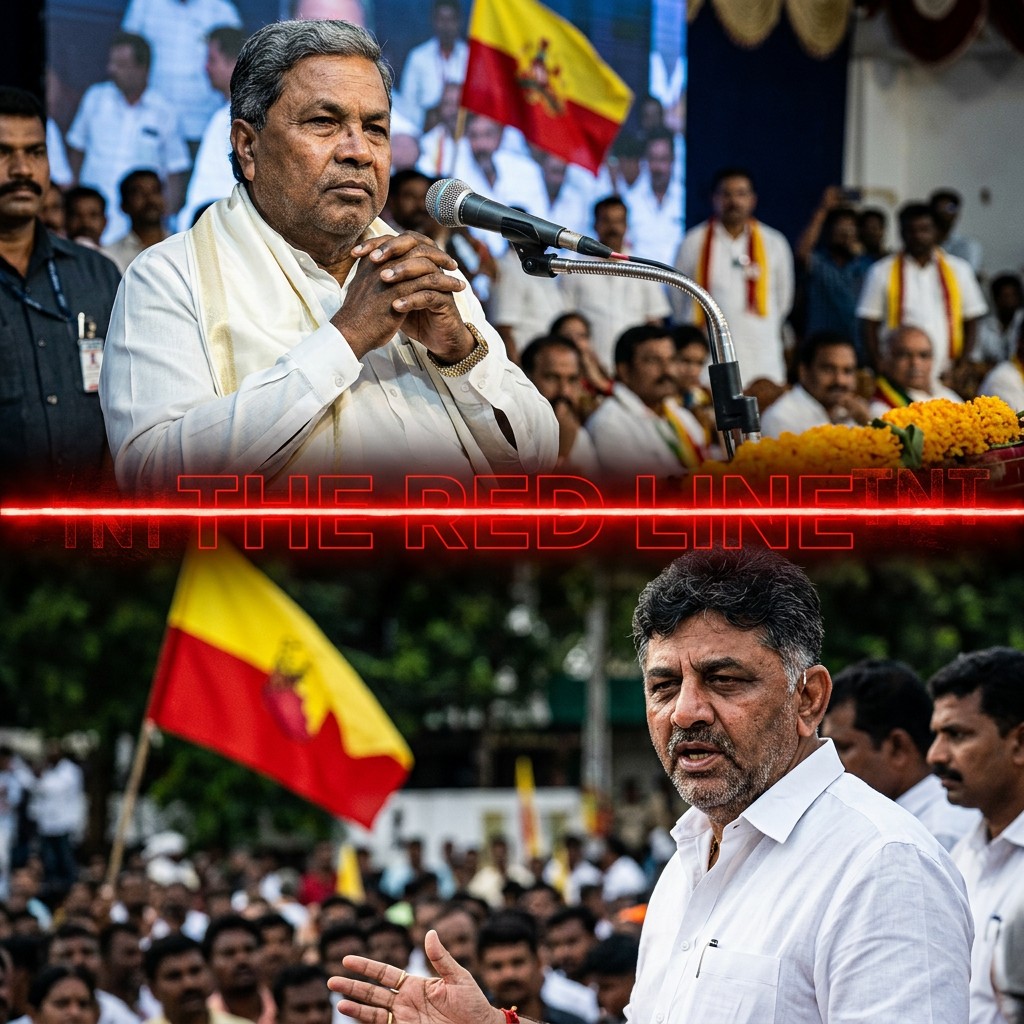
Siddaramaiah has sought an appointment with the Governor for May 28. DK Shivakumar is the frontrunner. Congress is executing an arrangement it publicly denied for three years. And the AHINDA coalition has no replacement.
Siddaramaiah has sought an appointment with Karnataka Governor Thaawarchand Gehlot for May 28, 2026 at 11 AM. Congress General Secretary Randeep Surjewala is arriving in Bengaluru to oversee the leadership transition to DK Shivakumar.
The Karnataka CM change 2026 is no longer speculation. Siddaramaiah’s office confirmed he has sought an appointment with Governor Thaawarchand Gehlot for May 28 at 11 AM, and Congress General Secretary Randeep Surjewala is flying to Bengaluru tonight. Here is what is happening, why it is happening now, and the question every outlet is missing: who replaces Siddaramaiah as the face of the AHINDA coalition that won Congress 135 seats in 2023.
- Siddaramaiah is expected to resign as Karnataka CM on May 28 at 11 AM, when he meets Governor Thaawarchand Gehlot.
- DK Shivakumar, current Deputy CM and KPCC president, is the frontrunner to succeed him.
- Congress General Secretary Randeep Surjewala arrives in Bengaluru on May 28 to oversee the transition.
- The Congress high command, including Rahul Gandhi and Mallikarjun Kharge, held a marathon Delhi meeting with both leaders on May 26 to broker the change.
- Siddaramaiah has been offered a Rajya Sabha seat. Sources indicate he is not interested in leaving Karnataka.
- His son Yathindra Siddaramaiah is reportedly being offered a significant role, possibly Deputy CM, as part of the arrangement.
- Congress publicly denied any power-sharing formula existed in 2023. They are now executing exactly that arrangement.
What is the Karnataka CM change 2026 and what happens tomorrow?
The appointment, the breakfast, and the arriving observer
Siddaramaiah’s Chief Minister’s Office confirmed on May 27 that he has sought an appointment with Karnataka Governor Thaawarchand Gehlot for May 28 at 11 AM, per India Today and Free Press Journal citing CMO sources. Congress insiders indicate he will submit his resignation letter at that meeting. Before the Governor meeting, Siddaramaiah is hosting a breakfast for the entire Karnataka cabinet at his Bengaluru residence on Thursday morning, a gesture widely read as a farewell to his ministerial colleagues. Congress General Secretary and Karnataka in-charge Randeep Surjewala is arriving in Bengaluru on Thursday to hold consultations with senior party leaders and oversee the transition process.
After Siddaramaiah’s resignation, the Karnataka Congress Legislature Party will meet to formally elect a new leader. DK Shivakumar, the current Deputy CM and Karnataka Pradesh Congress Committee president, is the overwhelming frontrunner, backed by the Congress high command. The Governor will then invite the elected leader to form the government. A swearing-in ceremony could take place as early as May 29 or 30, though no official date has been confirmed as of publication.
Why is Congress executing this change now, three years after denying it?
The formula that officially never existed
When Congress formed its Karnataka government in May 2023 after winning 135 seats, KC Venugopal held a press conference and was asked directly about a power-sharing formula between Siddaramaiah and Shivakumar. He said what Congress always says when it wants to deny an inconvenient arrangement.
“The only power-sharing formula is to share the power with the people of Karnataka.”
— KC Venugopal, Congress General Secretary, press conference, May 2023 Three years later, Venugopal’s successor Surjewala is arriving in Bengaluru to execute the arrangement Venugopal said did not exist.The Deccan Herald’s 2023 reporting is unambiguous: “The leadership has not given any assurance to Shivakumar on changing the Chief Minister as part of a power-sharing formula.” This was the official position. Privately, Shivakumar’s supporters insisted a rotational formula had been agreed, with each leader serving 2.5 years of the five-year term. Siddaramaiah completed 2.5 years in November 2025. For six months after that deadline, the Congress high command delayed. What changed in May 2026 was a convergence of pressures: upcoming Rajya Sabha and Karnataka Legislative Council elections, the need to consolidate the Vokkaliga vote bank before 2028, and Rahul Gandhi’s calculation that giving Shivakumar two full years before the state elections was the minimum required for him to establish himself as CM. The Delhi meeting on May 26, which lasted six hours, was the moment the private formula became unavoidable.
How does Siddaramaiah’s exit affect the Congress AHINDA coalition?
The caste arithmetic nobody is calculating out loud
This is the question every outlet covering the Karnataka CM change is sidestepping. Siddaramaiah is not simply a chief minister. He is the political face of the AHINDA social coalition, an acronym representing Alpasankhyataru (minorities), Hindulidavaru (backward classes), and Dalit communities, that delivered Congress its most decisive Karnataka mandate in years. He is the Congress party’s most prominent OBC leader in the state. DK Shivakumar, who will replace him, is a Vokkaliga leader. Vokkaligas are a dominant farming community concentrated in southern Karnataka, historically the base of the JD(S). Congress is swapping its AHINDA CM for a Vokkaliga CM, and there is no equivalent AHINDA face waiting in the wings.
AHINDA stands for Alpasankhyataru (minorities, primarily Muslims), Hindulidavaru (Other Backward Classes), and Dalits. Siddaramaiah spent decades building this social coalition as his political base. It is the primary reason the Congress party has consistently won in constituencies with high OBC and minority populations in Karnataka. The 2023 election was partly a referendum on AHINDA versus the BJP’s Hindutva consolidation. Congress won. Siddaramaiah’s departure removes the face of that coalition from the top post without a named successor to hold it together.
Congress’s calculation is that the guarantee schemes — Gruha Jyoti, Gruha Lakshmi, Shakti, Anna Bhagya, and Yuva Nidhi — will retain the AHINDA voter base even without Siddaramaiah as CM, while Shivakumar’s Vokkaliga identity opens up vote share in JD(S) strongholds. It is a gamble. No Indian state government has successfully separated welfare scheme loyalty from the political face who introduced them. The Congress high command is betting Karnataka can be the first. The 2028 assembly election will be the verdict. As TNT News Buzz examined in its analysis of Modi’s Europe tour diplomacy, Congress’s national strategy under Rahul Gandhi consistently prioritises caste coalition management over administrative continuity — and Karnataka is the highest-stakes test of that approach.
What did the Congress high command say? The public denial and the private decision.
Timeline: from the 2023 denial to the 2026 resignation
What does DK Shivakumar as Karnataka CM mean for the state in 2026?
Three years of the formula that did not exist: what Congress is actually gambling
The rotational CM formula was denied publicly, agreed privately, delayed for six months past its deadline, and is now being executed under the cover of a press conference that called it “only speculation.” That is an unusual sequence for a party that presents itself as institutionally disciplined. What it reveals is the tension at the core of Congress’s Karnataka success: the party won on the back of Siddaramaiah’s AHINDA identity politics and Shivakumar’s organisational muscle. It cannot retain both without giving each a turn at the top.
The question Karnataka Congress cannot answer publicly is this: if the AHINDA coalition delivers for the party’s 2028 candidates without Siddaramaiah as CM, what was the cost of replacing him with a Vokkaliga leader 18 months before the election window opens? And if it does not deliver, who in the Congress leadership takes responsibility for a coalition management failure that was entirely foreseeable from the moment KC Venugopal said the only power-sharing formula was sharing power with the people of Karnataka?
- Karnataka CM Siddaramaiah Likely to Resign on May 28 at 11 AM Free Press Journal, May 27, 2026
- Karnataka Congress Crisis: Siddaramaiah to Resign Tomorrow, Will DK Shivakumar Replace Him? Business Today, May 27, 2026
- How Congress High Command Convinced Siddaramaiah to Step Down as Karnataka CM Siasat.com, May 27, 2026
- Will Congress Remove Siddaramaiah as CM to Make Way for DK Shivakumar? The Federal, May 26, 2026
- Karnataka CM Change Is Happening: Resignation Likely Tomorrow The Statesman, May 26, 2026
- Siddaramaiah Is Next Karnataka CM, DK Shivakumar to Be Deputy Deccan Herald, May 2023
Dilshad is a journalist, filmmaker and digital marketing expert covering Indian foreign policy, national security and political economy at TNT News.
Leave a Reply