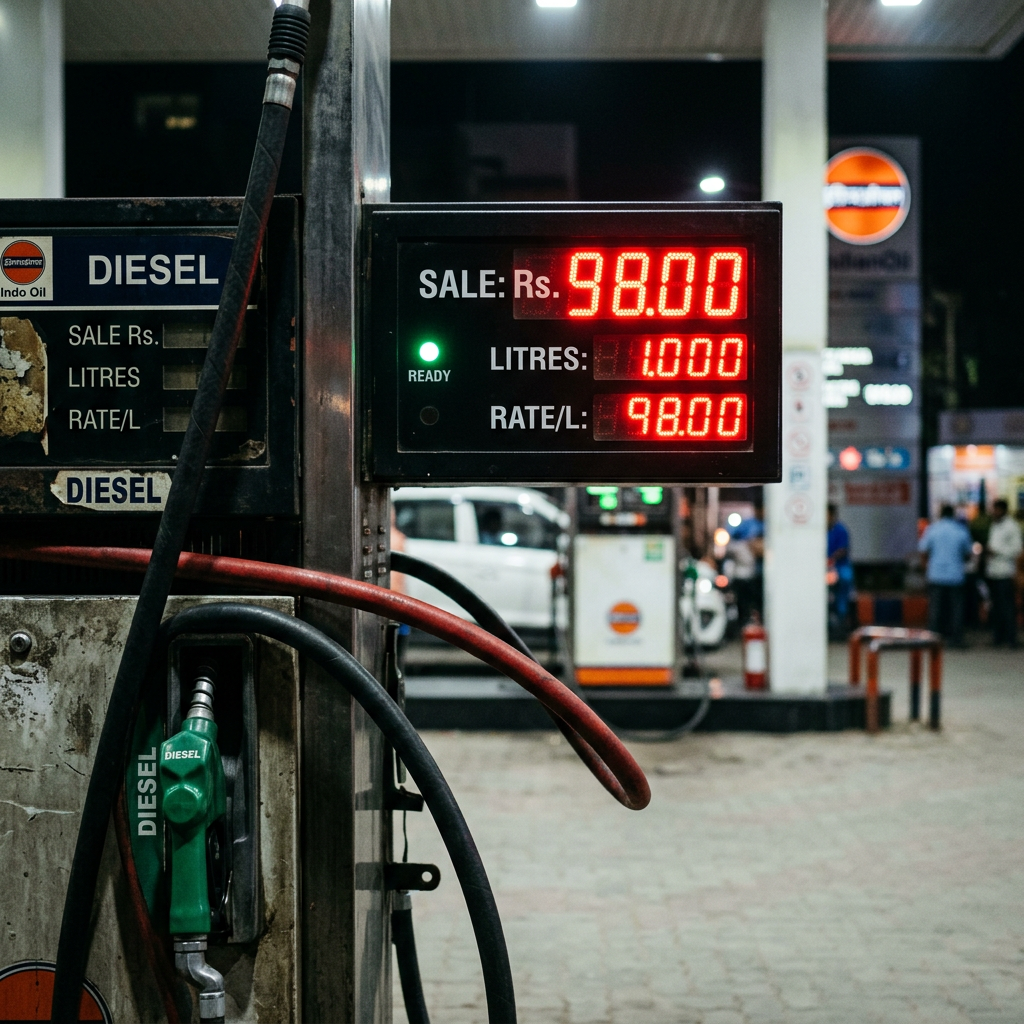
Rs 3.90 in 5 Days. 49 Months Frozen. Elections Just Over. | Petrol Price Increase 2026
India raised petrol and diesel prices twice in five days, on May 15 and May 19, 2026. The freeze lasted through four state elections. The correction has barely started.
India’s petrol price increase crossed Rs 3.90 per litre in less than a week, with state-run oil companies hiking fuel prices for the second time on May 19, 2026. Here is what changed at the pump today, why it happened now, and whether a third hike is coming before June.
Quick Answer: Petrol Price Increase 2026
- IOC, BPCL and HPCL raised petrol and diesel by Rs 3 per litre on May 15, 2026. First hike in 49 months.
- A second petrol price increase of 90 paise per litre followed on May 19, 2026. Total rise: Rs 3.90 in 5 days.
- Petrol price today: Delhi Rs 98.64. Mumbai Rs 107.59. Kolkata Rs 109.70. Chennai Rs 104.49.
- The first hike came exactly 16 days after assembly elections in 4 states concluded.
- MPC member Ram Singh publicly predicted post-election fuel hikes before results were declared.
- Industry sources say Rs 3.90 covers roughly one-tenth of the full correction needed.
- A third petrol price increase is likely. Budget Rs 300 to 500 extra per month on a 40-litre tank.
What is the petrol price today in India after the May 2026 hike?
India’s petrol price increase reached Rs 3.90 per litre in five days as IOC, BPCL and HPCL raised rates by 90 paise per litre on May 19, 2026, following a Rs 3 hike on May 15, with the petrol price today standing at Rs 98.64 in Delhi, Rs 107.59 in Mumbai, Rs 109.70 in Kolkata, and Rs 104.49 in Chennai, with diesel rising in parallel to Rs 91.58 in Delhi.
The May 15 petrol price increase was the first revision in 49 months. The two-hike sequence across five days is without precedent in India’s post-2022 fuel pricing history.
| City | Petrol (Rs/litre) | Diesel (Rs/litre) | Change |
|---|---|---|---|
| Delhi | 98.64 | 91.58 | +Rs 3.90 |
| Mumbai | 107.59 | 94.08 | +Rs 3.90 |
| Kolkata | 109.70 | 96.07 | +Rs 3.90 |
| Chennai | 104.49 | 96.11 | +Rs 3.90 |
The petrol and diesel price increase applies uniformly across IOC, BPCL and HPCL stations, which together control over 90 percent of India’s one lakh-plus fuel pumps. Private refiner Nayara Energy had already raised prices independently in late March 2026, months before the PSUs moved.
Why did India’s petrol price increase happen in May 2026?
Global petrol prices surged 50 percent after West Asia conflict
India’s petrol price increase in May 2026 is a direct consequence of global petrol prices rising from $69 per barrel in February 2026 to $113-114 per barrel in the weeks following the West Asia conflict, a surge of over 50 percent that state-owned oil companies absorbed for 11 continuous weeks, accumulating under-recoveries that made the May 15 revision financially unavoidable.
Officials from the oil ministry reportedly told Reuters that retailers were losing Rs 100 per litre on diesel and Rs 20 per litre on petrol at prevailing prices before the revision. IOC, BPCL and HPCL absorbed those losses for close to 11 weeks while Strait of Hormuz supply fears kept crude elevated.
The BJP defended the decision. IT cell convenor Amit Malviya argued that India’s petrol price increase of 3.2 percent was the lowest among major economies in the comparison period between February 23 and May 15, 2026. The claim is technically accurate. It does not address why 49 months of accumulated under-recovery were allowed to build while global crude remained volatile across three separate conflict cycles.
How does the petrol diesel price increase affect your daily costs in 2026?
Premium petrol price, freight rates and the inflation chain
The petrol diesel price increase of Rs 3.90 per litre will trigger a two to three month pass-through across India’s supply chains, with transport costs feeding into vegetable prices, manufactured goods and logistics-dependent services before the full inflationary effect appears in official CPI data, according to studies cited by The Week on May 15, 2026.
Premium petrol price at HP Power, Speed 97 and Shell V-Power stations rises proportionally above the revised base rates. Premium variants in Mumbai now cross Rs 115 per litre. Freight operators typically revise transport rates within 30 days of any fuel price change, meaning that the inflation knock-on from the May 15 and May 19 hikes will be visible in grocery and supply chain costs by late June 2026.
Congress leader Jairam Ramesh, writing on X on May 15, 2026, warned that the hike would push inflation toward 6 percent for the financial year and that growth estimates would be revised downward. The fuel price increase compounds the food cost pressure that TNT News Buzz documented in its analysis of El Nino 2026 and India’s urea crisis, where monsoon failure and fertiliser shortages are separately pushing food bills up from October 2026.
What is the timeline of India’s petrol price increase in 2026?
From the February crude surge to two hikes in five days
Will petrol prices increase again tomorrow or this week? A 2026 guide
A third petrol price increase before June 2026 is considered probable by industry analysts, as the Rs 3.90 total hike covers roughly one-tenth of the full correction needed against a 50 percent crude oil surge. Budget an additional Rs 300 to 500 per month on a standard 40-litre tank, and check your pump board before filling up. Prices can change overnight without public advance notice from oil marketing companies.
49 Months Frozen, 16 Days After Polling: The Fuel Price Pattern India Repeats Every Election Cycle
India’s petrol price increase on May 15, 2026, arrived exactly 16 days after assembly elections concluded in Assam, Kerala, Tamil Nadu and West Bengal, extending a pattern across multiple election cycles where state-run oil companies hold retail fuel prices steady through polling periods regardless of global crude movements, then revise upward once electoral risk has passed.
Monetary Policy Committee member Ram Singh had explicitly forecast post-election fuel hikes before results were declared. Nayara Energy’s March revision demonstrated that the commercial case for a revision existed weeks before the PSUs moved. As TNT News Buzz has documented in its analysis of a decade of economic decisions timed to political cycles, the fuel pricing pattern is one of the most consistent and least discussed features of how economic news is managed around Indian elections.
The petroleum ministry has not published a public methodology for how it determines when retail fuel prices should be revised, despite the timing having coincided with electoral calendars across 2019, 2024 and now 2026.
Has the petroleum ministry ever explained, in writing, why three successive post-election periods each produced India’s first fuel price revision in months?
Petrol and diesel prices have been raised twice in 5 days. Rs 3 on May 15, 90 paise on May 19. Total increase: Rs 3.90 per litre.
Delhi petrol is now Rs 98.64. Mumbai Rs 107.59. The hike came 16 days after state elections ended.
Industry says this covers one-tenth of the actual correction needed. More hikes are likely before June.
Full story: tntnews.buzz/petrol-price-increase-2026-india
Petrol Price Increase 2026: Frequently Asked Questions
Petrol price today in Delhi is Rs 98.64 per litre and diesel is Rs 91.58, after two hikes on May 15 and May 19, 2026. Mumbai petrol is Rs 107.59, Kolkata Rs 109.70, and Chennai Rs 104.49. Prices vary by state tax applied above the base rate.
A third petrol price increase before June 2026 is considered likely by industry analysts, as the current Rs 3.90 total hike covers roughly one-tenth of the under-recovery caused by global crude rising from $69 to $113-114 per barrel since February 2026. Check your pump board before filling up as prices can change overnight.
Global petrol prices surged over 50 percent after the West Asia conflict, pushing Brent crude from $69 per barrel in February 2026 to $113-114. IOC, BPCL and HPCL absorbed losses for 11 weeks before raising prices on May 15, exactly 16 days after four state elections concluded.
Diesel price today in Delhi is Rs 91.58 per litre after two revisions. Kolkata diesel is Rs 96.07, Chennai Rs 96.11, and Mumbai Rs 94.08. Both petrol and diesel rose by Rs 3.90 per litre in total across the May 15 and May 19, 2026 revisions.
BJP IT cell convenor Amit Malviya stated on May 15, 2026, that India’s 3.2 percent petrol price increase was the lowest among major economies in the comparison period. Global petrol prices rose over 50 percent in international crude markets from February to May 2026 due to West Asia conflict and Strait of Hormuz supply risk.
Sources
- First petrol-diesel price hike in four years might just be the beginning — The Week, May 15, 2026
- Petrol, diesel price today, 19 May 2026: Check fuel rates in Delhi, Mumbai, Kolkata, Chennai — Zee News, May 19, 2026
- India fuel price hike May 15, 2026: full market analysis — Multibagg, May 15, 2026
- Petrol Price Today, May 19, 2026 — Goodreturns, May 19, 2026
- Diesel Price Today, May 19, 2026 — Goodreturns, May 19, 2026
Dilshad is a journalist, filmmaker and digital marketing expert covering Indian foreign policy, national security and political economy at TNT News.
Leave a Reply