Quick Answer
Buddha Purnima and Labour Day 2026 falls on Friday, May 1.
The Purnima Tithi begins at 9:12 PM on April 30 and concludes at 10:52 PM on May 1.
It is a gazetted public holiday across India. Banks, government offices, and schools are closed in most states.
In Maharashtra, the day also marks Maharashtra Din. In Odisha and parts of Jharkhand and West Bengal, it marks the birth anniversary of Pandit Raghunath Murmu, creator of the Ol Chiki script for the Santali language.
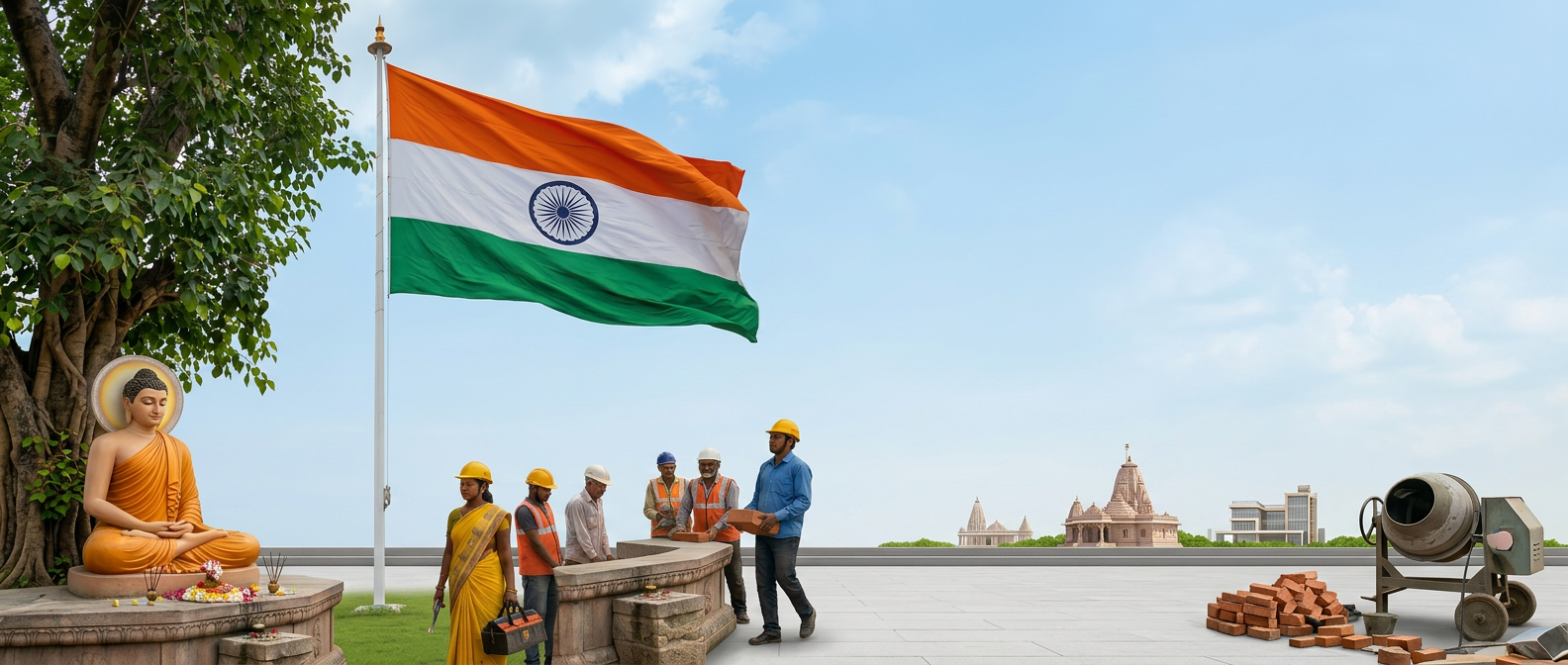
When Buddha met Marx: What happens when Buddha Purnima and Labour Day fall on the same day
Today is one of those rare calendar accidents that deserves more than a passing mention. May 1, 2026 is simultaneously four things at once: International Labour Day, Buddha Purnima marking the 2,588th birth anniversary of Gautama Buddha, Maharashtra Din commemorating the formation of Maharashtra state in 1960, and the birth anniversary of Pandit Raghunath Murmu, the Santali educator who gave an entire tribal civilization its written script and whose birthday falls on Baisakha Purnima each year.
Four observances. One date. And, as it turns out, one surprisingly coherent argument running through all of them.
Why May 1, 2026 is a rare convergence
Buddha Purnima does not have a fixed date on the Gregorian calendar. It falls on the full moon of Vaishakha in the Hindu lunisolar calendar, which shifts forward and backward each year relative to May 1.
The Purnima Tithi this year begins at 9:12 PM on April 30 and concludes at 10:52 PM on May 1, making today the principal day of observance. This overlap with Labour Day is not an annual event. It happens only when the Vaishakha full moon lands precisely on May 1, and the next time this coincidence will occur is years away.
It is also worth noting, before going further, what this coincidence is not. Buddhism and the labour movement did not plan to share a calendar date. They arrived at similar conclusions independently, separated by 2,500 years and half a world of geography. That is, if anything, a stronger argument for their compatibility than any planned alliance could be.
Buddhism, through its concept of Right Livelihood (Samma Ajiva), holds that work must cause no harm and must support both the worker and others. This places it in direct philosophical alignment with the core demands of the international labour movement.
What did the Buddha actually say about work?
The Noble Eightfold Path, Buddhism’s roadmap to the end of suffering, contains tucked in at step five a concept called Samma Ajiva: Right Livelihood.
Right Livelihood is the teaching that one’s work should be compatible with sound moral principles and should cause no harm. The Buddha was specific. He named five livelihoods that a lay follower should not engage in: trading in weapons, trading in human beings, trading in meat, trading in intoxicants, and trading in poison.
But Right Livelihood goes further than a prohibited list. Vipassana teacher S.N. Goenka defined it simply: “If the intention is to play a useful role in society in order to support oneself and to help others, then the work one does is right livelihood.”
Read that again slowly. Work that supports oneself. Work that helps others. Work done with intention, not desperation.
Now ask yourself: How many of India’s 12 million gig workers are doing Right Livelihood by that definition, and how many are simply surviving?
The Zomato delivery person and the Eightfold Path
India’s gig workforce has grown 55 percent, from 7.7 million workers in FY2021 to 12 million in FY2025, driven by smartphone penetration and the explosion of platform apps. Zomato, Swiggy, Ola, Uber, Urban Company. The platforms sell convenience to consumers and “flexible entrepreneurship” to workers.
The reality, as India’s own Economic Survey 2026 acknowledged, is considerably less enlightened. About 40 per cent of gig workers report monthly earnings below Rs 15,000. Opaque algorithms decide who gets to work and for how much. Worker accounts are deleted with little or no explanation, cutting people off from their only source of income.
Platform algorithms control work allocation, performance monitoring, wages, and supply and demand matching, raising serious concerns about algorithmic bias and worker burnout.
A Zomato delivery rider navigating Mumbai’s roads in 42-degree heat, earning Rs 12,000 a month with no insurance and no job security, is not practising Right Livelihood. He is practising survival. And the platform extracting value from his labour while classifying him as an “independent partner” to avoid providing benefits is doing something the Buddha would have had a specific word for. It begins with wrong.
Does Buddhism oppose algorithmic exploitation of workers?
A Zen teacher once put it this way: “The fundamental problem for all humanity is that you believe that you are there and I am here.” This, he said, is how Buddhism casts a critical eye on commercial enterprises. As long as we regard each other as the other, we will suffer profound abuses in the workplace.
The gig economy is, at its structural core, a machine for maximising the distance between I and you. The algorithm is the perfection of that distance. It removes the human face of the employer entirely, replacing accountability with a rating system and empathy with surge pricing.
Scholars have demonstrated that every Article of the Universal Declaration of Human Rights, including labour rights to fair wages, leisure and welfare, is upheld in Buddhist teachings. The Buddha did not write the UDHR. But the framework was already there, 2,500 years earlier.
What is the connection between India’s first Labour Day and Buddhist values?
Here is a fact that rarely gets mentioned on May 1: India was among the first Asian countries to formally observe International Workers Day. The first Labour Day in India was held on May 1, 1923, in Madras, organised by the Labour Kisan Party of Hindustan under Singaravelar Chettiar, a Tamil social reformer who drew equally from socialist and Dravidian reform traditions.
That original May 1 rally was not just about wages. It was about dignity. About refusing to accept that some people are worth less than others because of who they were born to or what work they do. That is, in essence, what the Buddha said too. In a caste-stratified society 2,500 years ago, he argued that all human beings possess equal dignity. As per Buddhist doctrine, there is no self, which means all are equal in the most profound sense.
The man who actually merged the two: B.R. Ambedkar
If there is one figure in Indian history who understood that Buddhism and labour rights were the same argument, it was Bhimrao Ramji Ambedkar.
Before he became the architect of the Indian Constitution, Ambedkar served as Labour Member of the Viceroy’s Executive Council from 1942 to 1946. In that role he did not theorise about workers rights. He built them, piece by piece, into law. At the 7th session of the Indian Labour Conference in New Delhi on November 27, 1942, Ambedkar formally reduced the industrial working day from 14 hours to 8 hours. He introduced equal pay for equal work, maternity benefits for women workers, the Employees State Insurance scheme, welfare funds for coal mine workers, and the legal framework for industrial dispute resolution. He drafted the Minimum Wages Act in 1942, which was enacted into law in 1948. He called the Congress government’s Industrial Disputes Bill of 1938 “bad, bloody and bloodthirsty” because it restricted workers’ right to strike. India’s entire modern labour law architecture sits on the foundation Ambedkar built in those four years.
Then came October 14, 1956. Six weeks before his death, Ambedkar stood at Deekshabhoomi in Nagpur and converted to Buddhism, leading approximately 365,000 followers in converting alongside him. He did not choose Buddhism for spiritual comfort. He chose it as a deliberate political act rooted in a lifetime of intellectual inquiry. He had examined Islam, Christianity, and Sikhism before concluding that Buddhism alone offered the foundational premise that Hindu caste society had always denied: that all human beings are born equal in dignity.
In the conversion ceremony, Ambedkar and his followers took 22 vows.
Among them: to follow the Noble Eightfold Path. To practise compassion for all living beings. To believe in the equality of all people and endeavour to establish it. To renounce any system based on inequality.
These were not religious vows in a narrow sense. They were the same demands he had spent his career fighting for in Parliament and in law, now restated in the language of Dhamma.
His final book, “The Buddha and His Dhamma,” published posthumously in 1957, reinterpreted Buddhism as Navayana, a New Vehicle explicitly concerned with social transformation and liberation from caste-based economic oppression. Ambedkar did not see Buddhism and labour rights as parallel streams. He saw them as one river.
Today, as trade unions march in Mumbai and as Buddhist communities light lamps in Nagpur, the city where Ambedkar’s conversion happened, both streams are visible on the same streets. He would not have found today’s date surprising at all.
A fourth voice on the same day: Pandit Raghunath Murmu
There is one more figure worth naming today, particularly for readers in Odisha, Jharkhand, and West Bengal. Pandit Raghunath Murmu, revered as Guru Gomke, was born on Baisakha Purnima in 1905, which means his birth anniversary falls on the same day as Buddha Purnima each year. Odisha has declared his birthday an official state holiday.
Murmu devoted his life to creating the Ol Chiki script for the Santali language, giving written form to a language that tens of millions of tribal people had spoken for centuries but could never read or write in their own tongue. This was an act of dignity and recognition for a community that Indian society had systematically excluded.
It was, in its own register, the same argument Ambedkar was making about Dalits, and the same argument the labour movement was making about workers: that no human being should be invisible to the systems that govern them.
Four observances. One argument. One date.
So: Is Buddhism compatible with labour rights?
Not just compatible. Foundationally aligned.
The labour movement says workers deserve dignity, fair wages, and protection from exploitation. Buddhism says work must not cause harm, must support both the worker and others, and must not be built on the suffering of fellow human beings.
Where they diverge is in method. The labour movement organises, agitates, and demands. Buddhism tends toward the inward, changing the mind of the employer rather than just the law. But in a country where the Code on Social Security 2020 formally recognises gig workers yet implementation remains painfully slow six years later, perhaps both approaches are needed simultaneously. The outer work of legislation and the inner work of recognising the person in front of you as fully human, not as a delivery slot in an algorithm.
Today, as temples light lamps for the Buddha and trade unions march through the streets of Mumbai and Chennai, it is worth sitting with the uncomfortable question this rare convergence raises: if the teachings of one of history’s greatest moral philosophers are genuinely compatible with the demands of the labour movement, and if the man who built India’s labour law architecture said so explicitly with his life, why are 12 million Indian workers still waiting for basic protections?
That is not a rhetorical question. It is the question May 1, 2026 is asking.
Frequently asked questions
Q1. Is Buddhism compatible with workers rights?
A. Yes. Buddhist teachings, particularly the concept of Right Livelihood (Samma Ajiva), hold that work must cause no harm and must support both the worker and society. Scholars have shown that every Article of the Universal Declaration of Human Rights, including fair wages and labour protections, is upheld by Buddhist doctrine. B.R. Ambedkar, who built India’s modern labour law framework and later converted to Buddhism, saw the two as expressions of the same principle: the equal dignity of every human being.
Q2. What did the Buddha say about work and livelihood?
A. The Buddha named Right Livelihood (Samma Ajiva) as the fifth step of the Noble Eightfold Path. He defined it as work that causes no harm to others and that supports both the worker and their community. He specifically prohibited livelihoods involving weapons, human trafficking, intoxicants, and poison. His broader teaching was that how a person earns their living is inseparable from how they live their moral life.
Q3. What is the connection between B.R. Ambedkar, Buddhism, and the Indian labour movement?
A. Ambedkar served as Labour Member of the Viceroy’s Executive Council from 1942 to 1946, during which he introduced the 8-hour workday, equal pay for equal work, maternity benefits, and the foundations of India’s social security system. He later converted to Buddhism in Nagpur on October 14, 1956, leading hundreds of thousands of Dalits in converting with him. He chose Buddhism explicitly because it offered a philosophical basis for equality that Hinduism’s caste system had always denied. His life was the argument that labour rights and Buddhist values are the same demand made in different languages.
Q4. When did India first observe Labour Day?
A. India observed its first Labour Day on May 1, 1923, in Madras, now Chennai. It was organised by Singaravelar Chettiar and the Labour Kisan Party of Hindustan. India was among the first Asian countries to formally observe International Workers Day.
Q5. Why do Buddha Purnima and Labour Day fall on the same date in 2026?
A. Labour Day is fixed to May 1 each year. Buddha Purnima falls on the full moon of the Vaishakha month in the Hindu lunisolar calendar, which shifts annually. In 2026, that full moon falls on May 1, creating the overlap. This coincidence is not annual and will not repeat for several years.
Sources
- India TV News. “Buddha Purnima 2026: April 30 or May 1? Check exact date, muhurat timings and how it is celebrated.” indiatvnews.com, April 2026. https://www.indiatvnews.com/astrology/budh-purnima-2026-date-and-time-muhurat-how-to-celebrate-buddha-purnima-significance-2026-04-08-1036799
- Down to Earth. “Economic Survey 2026: India’s fast-growing gig economy needs an overhaul.” downtoearth.org.in, January 2026. https://www.downtoearth.org.in/economy/economic-survey-2026-indias-fast-growing-gig-economy-needs-an-overhaul
- IDR Online. “The long road ahead for gig and platform workers in India.” idronline.org, February 2026. https://idronline.org/article/rights/the-long-road-ahead-for-gig-and-platform-workers-in-india/
- Learn Religions. “Right Livelihood: The Ethics of Earning a Living.” learnreligions.com. https://www.learnreligions.com/right-livelihood-the-ethics-of-earning-a-living-450071
- Interfaith Worker Justice. “Buddhism.” iwj.org. https://www.iwj.org/resources/buddhist
- Buddhistdoor Global. “A Buddhist Understanding of the Dharma and Human Rights.” buddhistdoor.net, October 2023. https://www.buddhistdoor.net/features/a-buddhist-understanding-of-the-dharma-and-human-rights/
- NewsBharati. “Dr Ambedkar: The Architect of India’s Labor Reforms.” newsbharati.com, April 2021. https://www.newsbharati.com/Encyc/2021/4/15/Ambedkar-Labor-reforms.html
- Secular Buddhist Network. “Dr. Bhimrao Ramji Ambedkar: A Secular Buddhist Vision for Liberation.” secularbuddhistnetwork.org, April 2025. https://secularbuddhistnetwork.org/dr-bhimrao-ramji-ambedkar-a-secular-buddhist-vision-for-liberation/
- Wikipedia. “Dalit Buddhist movement.” en.wikipedia.org. https://en.wikipedia.org/wiki/Dalit_Buddhist_movement
- Wikipedia. “Raghunath Murmu.” en.wikipedia.org. https://en.wikipedia.org/wiki/Raghunath_Murmu
Leave a Reply